
America On Hold

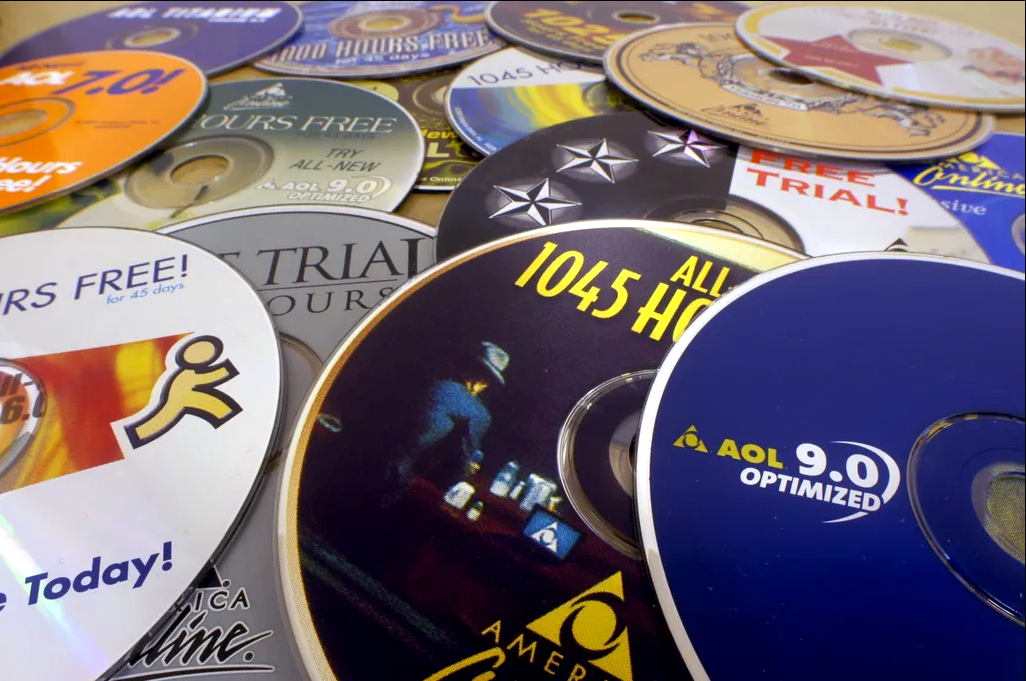
I had all of these CDs stuck to my bedroom wall when I was a kid. I do not remember asking for them. They were just there. Shiny and everywhere. I remember getting them in the mail, and I know I once saw a kid try to melt one with a grill lighter. When I started looking into the history of those CDs, I realized that these nostalgic childhood objects I stuck on my wall were part of something enormous, and the more I thought about them the more they felt haunted.
But at the start, the thing that pulled me in was really just a question. I mean, how would you sell the internet? I can barely explain what it is, and I wrote two episodes of this show about the DNS. If you were to ask me to somehow pitch the internet to someone who had never experienced it, I'm not sure what I'd say.
The more I thought about it, the more I realized that giving it away, physically, was a kind of genius. And there is a person behind that decision. I got this image of a woman sitting in a conference room insisting on one disc and that disc being a door to the internet for millions of people. That alone felt like a story. But then the question was how does the story end? That's when it started feeling haunted.
A billion discs. All that plastic. All that packaging. People throwing them out because they were everywhere. And most of them are still somewhere, in the ground. At the same time, there are still millions of people in the US without broadband. The story never ended. It feels unresolved. I tried to write the episode to reflect that feeling.
I am writing these in the order that they come to mind. Or in the order I get most interested in something. So there is no master plan. But I can give you a hint about what I'm working on next.
The story starts with a chemist who absentmindedly dips his pen into molten tin. A single, fleeting moment of clumsiness at a desk. That small accident will lead to one of the most consequential materials in human history, and into the strange, precise art of turning something common into something almost impossible.
What Didn't Make It In
Here are a few things that I just couldn't fit into the story:
Modem banks
In the early days of dial-up, getting online meant dialing a specific local access number. On the other end of that number was a modem bank. It was a physical room lined with racks of machines connected to phone lines. Your computer was not reaching into the air. It was calling one piece of hardware bolted into a rack somewhere nearby. If every modem in that room was busy, you heard a busy signal. If you dialed a number outside your area, you could be charged long distance fees. The limits of the internet were the limits of how many boxes could fit in a room.
More about Jan
Inside AOL, Jan Brandt was called "the Queen of No." As colleagues tried to add features, legal language, or extra steps to the free trial, she refused. She believed that any friction between a person and that first moment of connection would break the spell. Her insistence on one disc, one action, one doorway was not accidental. It was defended again and again in conference rooms.
The protest movement
By the early 2000s, the discs had become so common that a small protest movement formed around them. A website called No More AOL CDs was created by Jim McKenna and John Lieberman in California. They wanted to collect 1 million CDs and dump them at AOL headquarters. They never got to a million, but discs were sent to them for years.
The Internet Archive's AOL CD Collection
The Internet Archive has been collecting AOL CDs since 2015, led by archivist and historian Jason Scott. The goal is to document every unique variant that can be found, and there were thousands. I had the chance to briefly meet Jason Scott at a software preservation conference in Mexico back in 2019. During the meeting he was part of a panel discussion and at one point said, “We have a complete history of nothing.” That phrase has stuck with me and is part of why this collection stood out so much when I started researching this episode. You can browse the collection at https://archive.org/details/aolcds.

Don't forget to subscribe, rate, and review wherever you listen 💚
Support the show at Buy Me a Coffee.
The Episode
Script
I was born in nineteen eighty-nine, which means I was maybe seven or eight when I first started noticing the discs. At the grocery store, there was always a little stack of them near the gum. We found them inside cereal boxes. At some point we had so many we stuck them on our bedroom walls.
You would balance them on your index finger and look at your reflection. A tiny funhouse mirror full of rainbows.
They were just part of the texture of being alive in America in the 90s. Like 'Got Milk?' commercials. Or the smell of scented markers. I didn't know what they were for. I just knew they were everywhere.
Someone put them there.
I'm Daina Bouquin. This is Found in the Machine.
...
Her name was Jan Brandt. On Friday nights, she went to Blockbuster. She'd pick up eight movies at a time because she didn't know what mood she'd be in by Sunday. One night she noticed a box by the register. Inside were product samples. You'd get a box free if you rented three movies. So she took two boxes, walked into her office at AOL on Monday morning, and said, we need to put a disc in here.
Jan Brandt had come up as a copywriter, moved into sales, and eventually shifted to direct mail marketing. That work taught her something most marketers don't learn. The physical object you pull from the mailbox is doing work before it ever gets opened. The weight of it in your hand. It can shape the decision, in a fraction of a second, about whether to open it or throw it away.
She had developed an absolute belief. A belief that you could not send someone a real package in the mail and have them not open it. A package. Not an envelope. Something you could really feel.
In 1993, AOL CEO Steve Case brought her in with a mandate: grow the subscriber base. She was given control of AOL's entire marketing strategy. So she set out to make the internet feel inevitable.
To understand what that meant, you need to remember what getting online actually looked like in the early 90s. Before AOL simplified everything, connecting to the internet was a genuinely technical act. You had to find a local access number for your area. You had to understand protocols. And if you didn't, you had to read a manual. Brandt had sat in focus groups watching people try to figure out computers for the first time. One person held the mouse in the air, pointing at the TV screen like a TV remote. She remembered seeing another put it on the floor and try to work it like a sewing machine pedal.
They were not going to read a manual. They were not going to configure anything. And they were everyone.
The internet was not a place most Americans had been, and it was a place that required you to already know your way in. AOL was trying to change that. But at the time it was a distant third, or fourth, in the online services market. And almost nobody could explain what the internet actually was in a way that made someone want it. It made advertising nearly impossible. You couldn't put it on a billboard. You couldn't capture it in a TV commercial. But what you could do was put it in someone's hand.
...
Each of those discs had a clear polycarbonate core, a thin aluminum layer to hold the data, and a coating of lacquer on top. Light and cheap to make. Not biodegradable. Brandt's team could produce them by the millions and ship them everywhere. And she intended to.
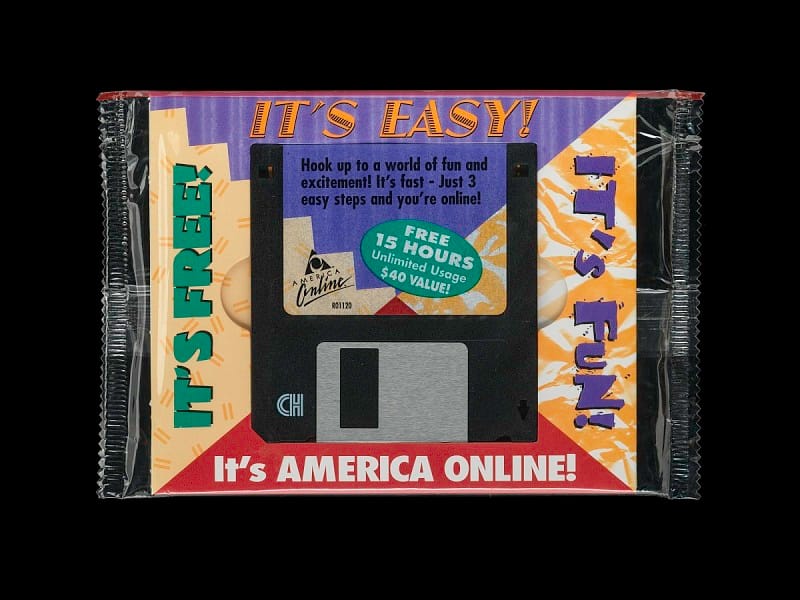
She launched what she herself called a "carpet bombing strategy." It started with floppy disks in 1993 and shifted quickly to CD-ROMs. The strategy wasn't just to mail them, it was to make them inescapable. The discs turned up in magazines next to the perfume samples. They were at the bank by the deposit slips. In your fast food order with your napkins. On the airline meal tray between the pretzels and the ginger ale. If your eyes landed somewhere, the odds were decent that a disc was nearby. And then there were the Omaha steaks.
Omaha Steaks shipped frozen orders all over the country. Brandt wanted a disc in every package. The problem was obvious. It would have to survive being frozen solid, thawed, then stuck in someone's computer. Before her team could commit, they flash froze a floppy disk, let it thaw, and found out whether it still worked. It did. The disk went out with the steaks.
As the software grew more complex, the pressure to go to two discs grew with it. She absolutely refused. She was, in her own words, "crazed about it." Getting the disc into someone's hand was worthless if it came with friction. The whole point was that you picked it up, you put it in, and the door opened.
One disc, one step, one door.
She understood that the internet wasn't something you could sell. You could only give it away. And you had to give it away until people forgot there was a time before it.
The scale of what followed is almost impossible to comprehend. At the peak of the campaign, AOL had distributed over a billion free trial discs. 50% of all CD-ROMs manufactured in the entire world bore the AOL logo. Not 50% of promotional discs. 50% of all discs, including music albums and software. The campaign cost at least $300 million. But AOL grew from 200,000 members to over 22 million. At its peak, they were signing up new subscribers every six seconds.
...
And then the system broke.
In December 1996, AOL switched to flat rate pricing. Unlimited access for a monthly fee. It was the right call competitively. And it was also a disaster. The number of people trying to connect at once overwhelmed the infrastructure completely. On some evenings, roughly 15% of subscribers got a busy signal just trying to log on. Attorneys General around the country threatened lawsuits. AOL promised refunds. Steve Case made a commercial telling people the company was working day and night to fix it.
The public dubbed the company "America on Hold."
The campaign had worked. Brandt had gotten so many people through the door that the door was jammed.
As the infrastructure caught up and the congestion eased, the discs kept coming. But they had become a type of cultural noise. Everyone had stacks of them. Nobody needed more.
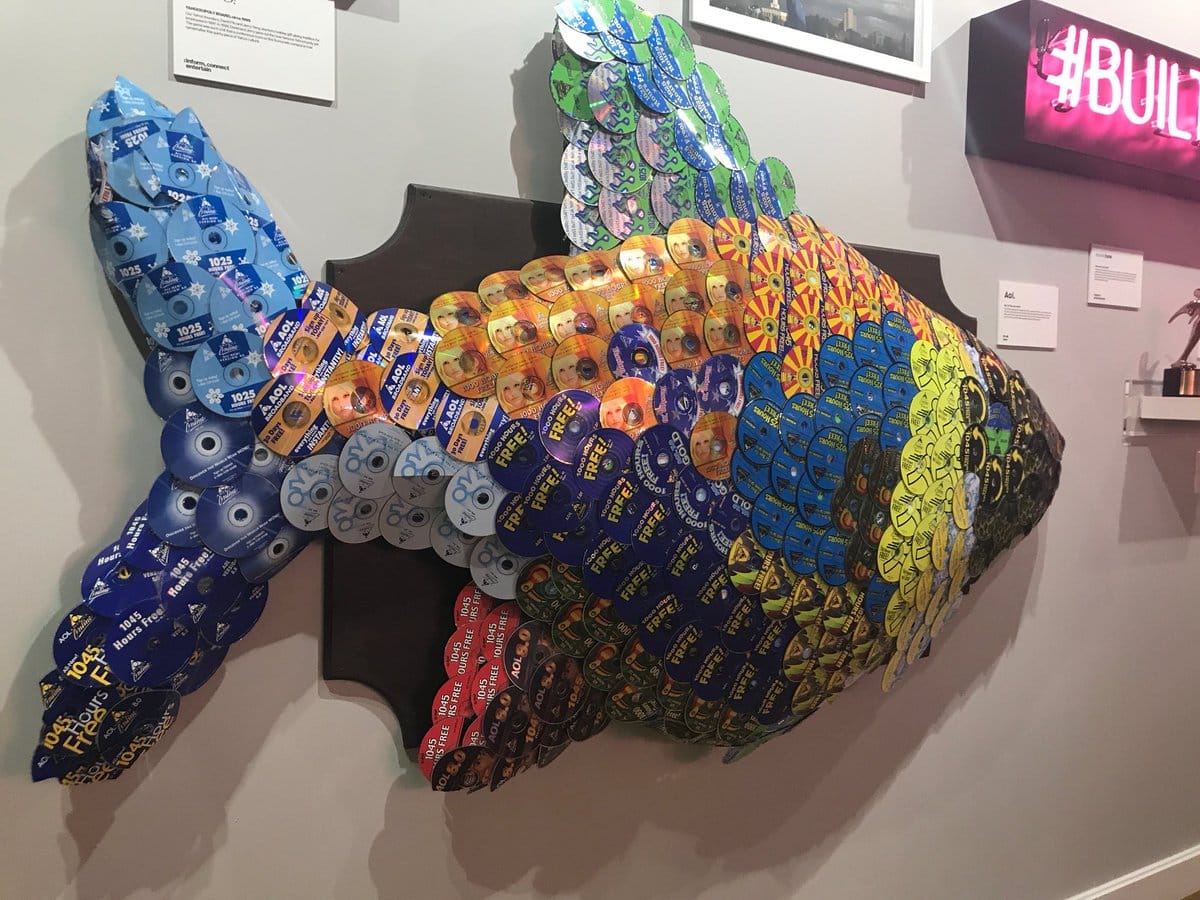
They were mocked in the press. PC World's readers voted them the most annoying tech product of all time. And because the discs were everywhere, the physical objects began a second life. The blue and white disc that had been millions of Americans' first contact with the internet became raw material.
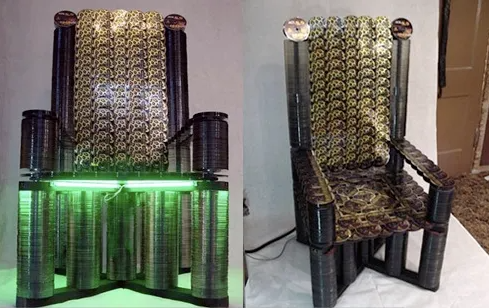
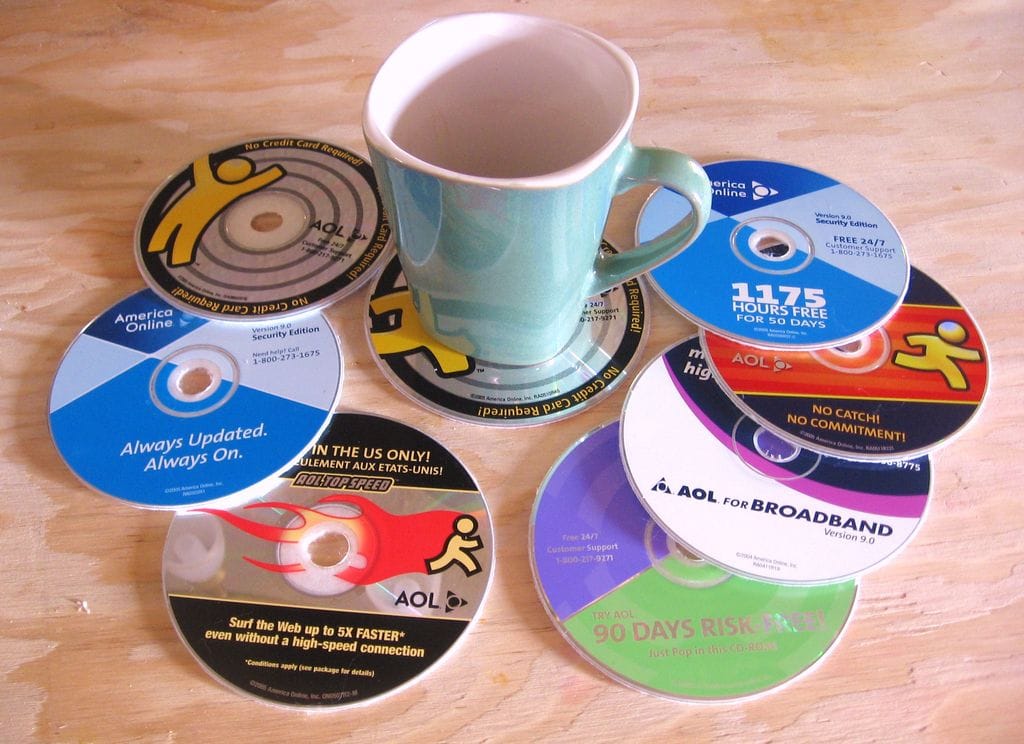
People used them as coasters. They hung them in gardens as suncatchers, shattered them to make lampshades and bowls. One collector eventually built a glowing 150-pound throne out of 4,000 of them.
And one of the early floppy discs was mailed to a man named Bernard S. Finn, promising 15 hours of free access. He never opened it. He just kept it. That disc is now in the collection of the Smithsonian National Museum of American History. Among the things the country has decided are worth remembering.
Over a billion discs. The ones that didn't become folk art or end up in a museum mostly went in the trash. The ones that went in the trash are still there.
...
Then, if you lived in the right place, broadband arrived. Getting online was no longer an event you prepared for. The connection was just there. The way water is there when you open a tap. By 2007, AOL had retired the campaign.
They had mailed mountains of plastic across the earth so we could leave the physical world behind. And for most of us, it worked.
But broadband did not arrive everywhere. A rancher in Montana still prints USDA forms and pays for postage. A student in Alabama does her homework in a McDonald's parking lot to access WiFi.
Laying fiber optic cable can cost anywhere from tens of thousands to hundreds of thousands of dollars per mile, depending on terrain, soil, and how many households a mile actually passes. Nobody agrees on the exact numbers. What everyone does agree on is that the math doesn't work.
In a city, a mile might pass thousands of households. In rural Wyoming, it might pass three. No private company has ever fixed that equation. And no public policy has either. As of the 2024, 7.9 million American households were completely offline. AOL suspended all remaining dialup service in 2025. Millions of people still can't access broadband. On tribal lands, that number is nearly one out of every four people.
For them, the only option is likely their cell phone, when they can get a signal. It's that or satellite, and satellite isn't available everywhere.
If you are one of these people, you remain isolated. The internet never became invisible. It's something you still need to work for.
...
Jan Brandt handed millions of people the physical edge of something enormous. She gave us that moment when connection was something you could hold in your hand. It was round. And your fingerprints got all over the back.
Now all that plastic waits in landfills. And in a farmhouse, somewhere without broadband, the people wait. I'm Daina Bouquin. This is Found in the Machine.
Sources
Blakemore, E. (2015, October 13). Remember these free AOL CDs? They're collectibles now. Smithsonian Magazine. https://www.smithsonianmag.com/smart-news/aol-cd-rom-collecting-thing-180956902/
Case, S. [America Online]. (1997). We're working day & night to fix it [Video]. YouTube. https://www.youtube.com/watch?v=vdp9MJczP5w
Fiber Broadband Association & Cartesian. (2024). 2024 fiber deployment cost annual report. Fiber Broadband Association. https://fiberbroadband.org/resources/2024-fiber-deployment-cost-annual-report/
Harris, B. (2020, June 27). Homework in a McDonald's parking lot: Inside one mother's fight to help her kids get an education during coronavirus. The Hechinger Report. https://hechingerreport.org/homework-in-a-mcdonalds-parking-lot-inside-one-mothers-fight-to-help-her-kids-get-an-education-during-coronavirus/
McCullough, B. (2014, August). She gave the world a billion AOL CDs: An interview with marketing legend Jan Brandt [Podcast episode]. Internet History Podcast. https://www.internethistorypodcast.com/2014/08/she-gave-the-world-a-billion-aol-cds-an-interview-with-marketing-legend-jan-brandt/
National Telecommunications and Information Administration. (n.d.). Data Central. U.S. Department of Commerce. https://www.ntia.gov/topics/data-central
Ramo, J. C. (1997, September 22). How AOL lost the battles but won the war. Time. https://time.com/archive/6731455/how-aol-lost-the-battles-but-won-the-war/
Smithsonian Institution. (n.d.). America Online (AOL) disc [Object record, NMAH catalog no. 2010.3015.05]. National Museum of American History. https://www.si.edu/object/nmah_1395721
Don't forget to subscribe, rate, and review wherever you listen to podcasts 🖤