
Cry Wolf

Camera Traps, Waiting, and Seeing
I think it's a very common frustration to wave your hand under a soap dispenser and have nothing happen. The little sensor struggles to recognize you and do its job.
This episode started for me at that soap dispenser while I was delayed in an airport a few weeks ago. I just got curious how those sensors work (or don't), so I started googling.
I found out that the bathroom sensors we interact with are mostly active infrared detectors, which sort of threw me. I guess I had never realized that infrared sensors come in active and passive forms. It just never occurred to me.
Once I realized though that there are different kinds of sensors, I got curious about why we use one or the other type in different contexts. I went down a rabbit hole after that about trail cameras and their history and just couldn't get it out of my head, so I decided to try turning it into a story for the show. It's a bit different from my usual episodes but I thought I might be able to land it, so thanks for sticking with me on this little experiment.
What didn't make it in
As always, building the narrative meant leaving a lot on the cutting room floor. Here is what didn’t make it into this episode:
- The 1970s Patent Maze: There is a whole, complicated series of patents starting in 1969 associated with the development of passive IR detectors that I had to bypass entirely. There are too many characters without much biography to go on and the story just ballooned and became an explainer about curved mirrors and thermistor ballometers. It wasn't working. I decided to just focus on explaining the mechanisms instead of the convoluted journey.
- Augustin Fresnel: The 19th-century French physicist whose lighthouse lenses were eventually miniaturized to make these motion sensors work. His actual life story is incredibly interesting, but it took us too far off the trail. He was actually a bridge engineer who argued (correctly and against much push back) that light behaves like a wave. He died early and I just didn't get to really tell his story.
- The Errors of Observation: I left out a lot of information about just how common it is for people to misidentify wolves in the wild. There have been dozens of misidentifications leading to accidental shootings, but I couldn't find exact numbers outside of a few press releases and stories. I'm personally not a dog person but I care a lot about conservation and this just felt tragic.
- The Algorithms: There was an entire section I cut that went in-depth on modern animal identification software and specific citizen science projects trying to sort through the endless mountains of camera trap data. It became a whole aside that was feeling like an overly long explanation of machine learning, so I decided to generalize instead just to explain the mechanics.
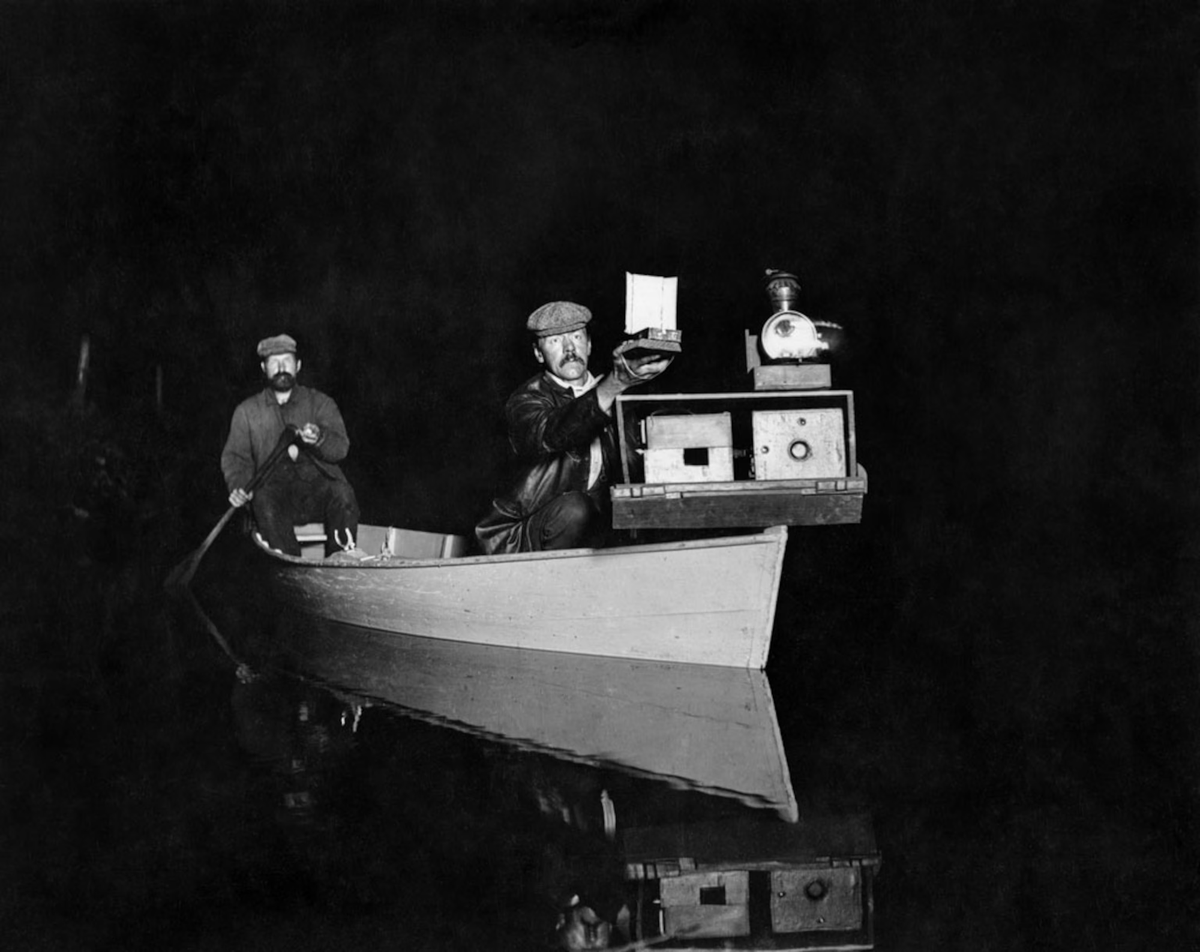
- National Geographic Drama: We touched on George Shiras and his early flash photography, but I left out the fallout at National Geographic. The magazine published a collection of his nighttime wildlife photos that were so controversial that board members actually resigned in protest over the magazine's decision to include them. They didn't really publish images at the time and the people who were against it thought it would lower the magazine to being more like a picture book than a serious publication. Despite this, the magazines sold like crazy and Shiras was later appointed to the board from which his detractors resigned.
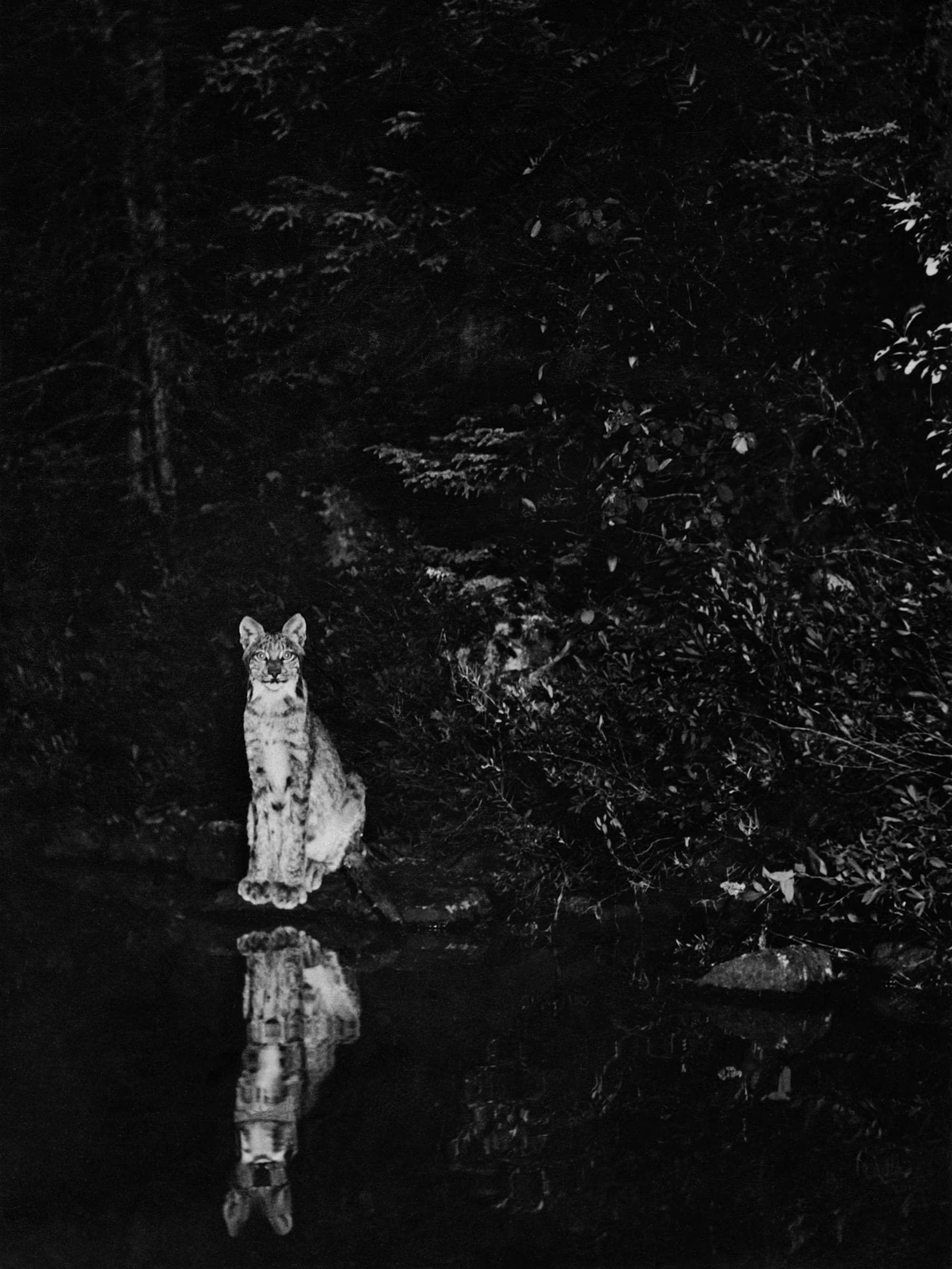
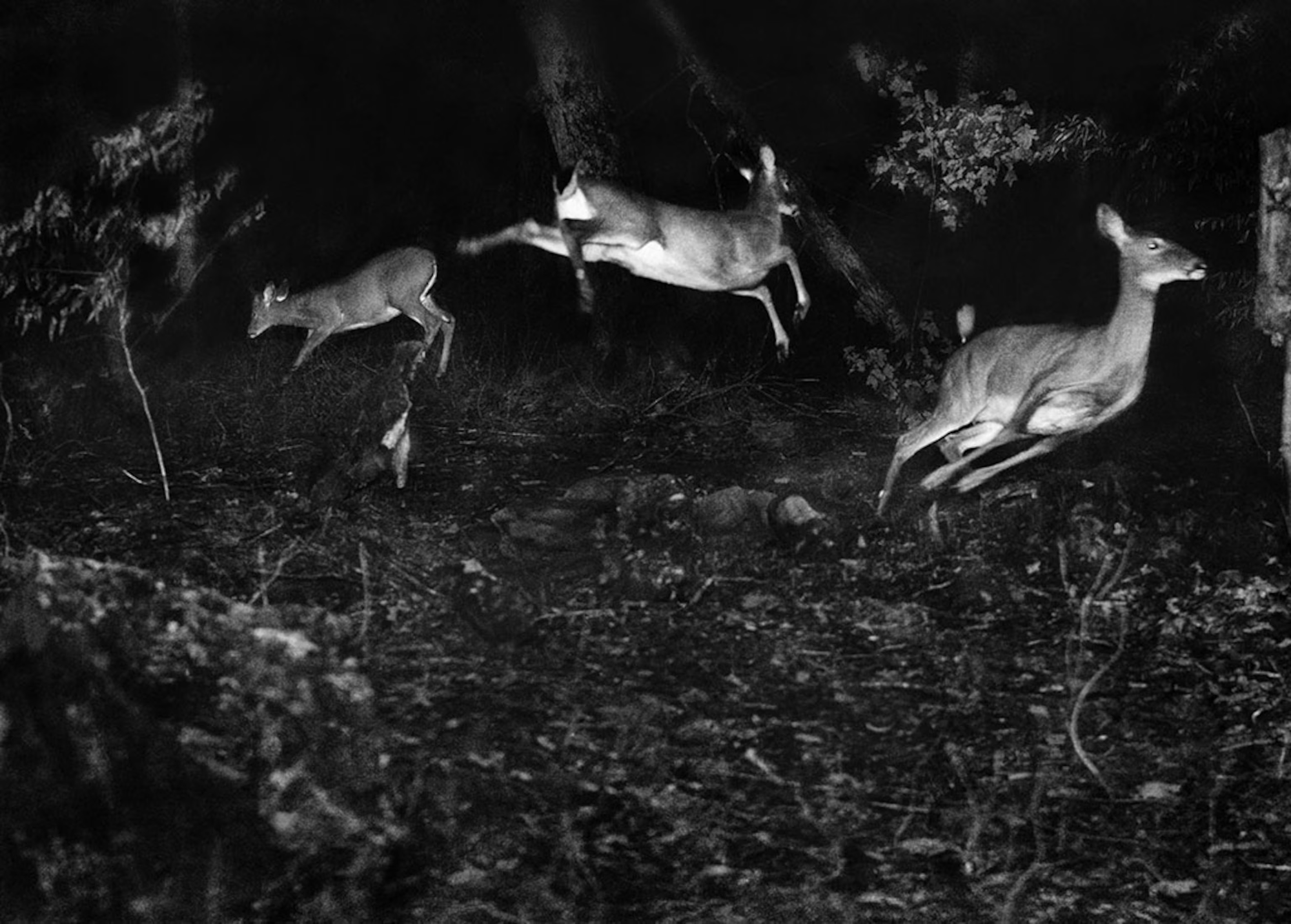
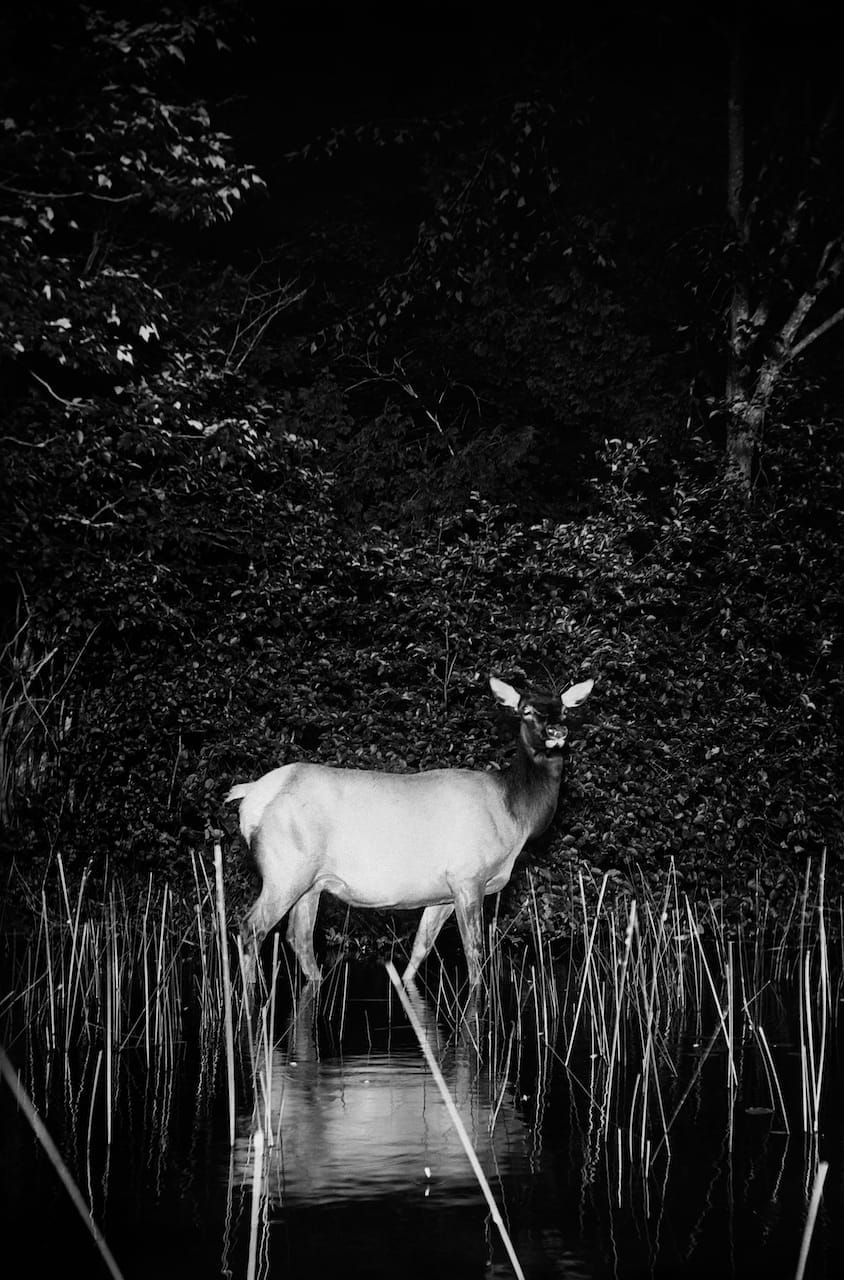
Photos by George Shiras via https://hyperallergic.com/the-first-flash-photographs-of-the-natural-world-at-night/
From the Field
I was laid off from my day job this past week, and to say it was unexpected would be a huge understatement. This change has really thrown my world out of balance, but I'm trying to be proactive and keep this show going.
If you're able to support, it would really mean a lot right now. I started a Patreon where I'll be offering bonus mini episodes as part of a series called Found in the Margins. New bonus stories will go out every other week alternating with the full episodes. I posted the first one in the main feed to let you check it out.
The Episode
Script
It is 1893. A damp dark night on a lake in northern Michigan.
Two men sit in a rowboat drifting along the reedy edge. In the stern, John Hammer holds a wooden paddle and keeps their progress quiet. At the bow, a wooden frame balances two heavy box cameras side by side. Each holding a single sheet of glass coated in light-sensitive emulsion. One exposure.
Above them, a kerosene lamp with a reflector throws a single sharp spear of light across the water. Behind that beam, hidden in the shadows, George Shiras holds a small pan of magnesium powder.
They watch the shoreline until a pair of eyes catches the light. Twin emerald points in the brush. A deer stands frozen, transfixed by the lamp.
The boat creeps closer.
Fifty feet. Forty feet. Thirty.
Shiras squeezes the trigger. There is a crack, a white hot hiss. For a fraction of a second, the deer, the hills, the lake all stand out in dark daylight. Then the smoke rolls over the water and the blackness rushes back in.
When they develop the plate, the deer is still there, stunned at the water's edge, alive and fixed in glass. But the only creatures they can capture this way are the ones that come to the shoreline. Shiras wants to see the rest of the forest.
And he is at his core a hunter. He knows the woods by habit, by patience. He knows where the deer walk. So he carries the heavy camera into the woods, stretches a single black thread across an animal path, and connects it to the shutter and the flash. Then he leaves.
Sometime after dark, a body crosses the trail. The thread tightens, and the darkness turns white.
In the morning, the deer is there on the glass. Shiras has built a camera that waits. His thread has given it a sense of touch. But the thread sags in the rain. It tangles. And it cannot catch a bat or a bird. Or anything that steps over it or under it.
To remove the thread, the camera needed to feel more than pressure. It needed to feel heat.
I'm Daina Bouquin, and this is Found in the Machine.
Every warm thing gives off invisible light. Infrared radiation. A deer. The raccoon beside the trash cans. You, right now, you are glowing, broadcasting your presence wherever you are.
But if you warm up a piece of tourmaline, it doesn't just glow. It begins to pull at the world around it. Dust, ash, and tiny pieces of straw cling to its surface. Inside the stone, a change in temperature shifts its electrical balance and creates a faint charge at the surface. Not heat in electricity out exactly. A change in temperature in. A fleeting electrical signal out.
That signal can be amplified. It can be used to close a circuit. It can wake a camera.
This is pyroelectricity.
But a single detector cannot tell what caused the temperature to change. To a stone, warmer is simply warmer. The sun rising over a clearing warms the air. The detector warms. Wire that detector to a camera and it will confidently photograph the empty field.
To use pyroelectricity, to make the signal useful, engineers needed the machine to also notice movement. So they paired two pyroelectric elements together and balanced them against each other like two sides of a scale.
When a slow even shift in temperature, like sunlight warming a room, reaches both elements at once, the scale stays balanced. That broad change produces silence. But if a body moves through the room, it warms one element and then the other. For a fraction of a second, the scale tips. That disagreement becomes a trigger, telling a camera to wake up.
This is what happens with the floodlight above your driveway. With the lights that turn on when you enter a room. It's what happens inside a camera trap. The sensors in those little machines do not see you. They contain pyroelectric elements that just notice when the infrared patterns in front of them briefly stop agreeing with each other.
It is called a passive infrared sensor because it sends nothing into the world. No beam, no searching pulse. It simply waits for the invisible light already being emitted around it to move in a certain way.
But even with two pyroelectric elements, the sensor still needs help to focus all that infrared light. And it turns out the cheapest solution came from the sea.
From the work of an early 19th-century French physicist named Augustin Fresnel. Fresnel designed a new kind of glass for lighthouses, made of step-cut concentric rings that could gather the scattered, wasted light that flew towards the land instead of the water. His lens bent the lighthouse's brightness into a single intense beam aimed at the horizon so the ships could see the light from further away.
Now if you look at the milky plastic window on a motion detecting light, or a burglar alarm, or a trail camera, you will see a pattern of tiny molded ridges. That is a Fresnel lens, molded in plastic. Cheap and easy to make. But instead of throwing visible light out into the dark to warn ships, it reaches out and gathers up the scattered invisible light and bends it inward toward the sensor.
Now take that sensor with its paired elements and its inside-out lighthouse lens and strap it to a tree on the coast of British Columbia.
In Heiltsuk territory, an invasion was quietly taking hold under the water. European green crabs were moving in. They threatened the native clams, the salmon, the eelgrass. So the Nation's Environmental Guardians fought back. They sunk traps into the deep water, baiting them with herring and sea lion meat.
But the traps started coming back broken. The Guardians would find the cages dragged out of the water, netting shredded, the little orange bait cups mangled or completely missing. Sometimes a trap vanished entirely. At first they guessed it was sea lions or maybe otters, but the damage didn't quite make sense.
They needed to know what was happening beneath the surface. So they pointed a camera at the surf to watch.
Then, one day in May 2024, the sensor registered a change in temperature on the shore. The camera woke up. It recorded a female coastal wolf. In this territory, the wolves are different.
They cross open water between islands with their backs submerged, only eyes and ears and snouts above the surface. They bite the heads off spawning salmon and eat only the brains. Crack muscles with their jaws.
But this wolf wasn't hunting in the tide pools. The camera caught her wading into the cold salt water. She swam out until she reached a floating buoy attached to a crab trap. She grabbed it in her jaws and swam back, dropping it on the rocks. Then she took the rope in her mouth and she pulled. She stood on the shore, pulling the line over and over, understanding that this rope connected to something that she could not see, heavy and hidden in the depth. She dragged the awkward contraption all the way onto the beach and tore through the mesh. She extracted that little orange bait cup, licked the sea lion meat clean, and trotted away.
In less than three minutes, the camera solved the mystery. It recorded a wolf executing a deliberate multi-step heist. It captured the animal understanding a cause and effect relationship that scientists didn't know wild wolves were capable of grasping.
But the camera that caught the wolves hauling in crab traps also caught many, many, many things that were not wolves. A branch warmed by the sun swinging across the field of view, the camera wakes. A patch of light lands suddenly on wet leaves and the camera wakes. For every photograph of a wolf on a beach, there may be dozens with nothing in them at all.
Nothing, nothing, nothing. Wolf. Nothing. Again.
But a false alarm only wastes time. A missed animal can rewrite the record. It can say "Nothing was here."
For 30 years, engineers tried to make the signal itself smarter. They filtered waveforms and analyzed pulse shapes. But the size and signal depends on how warm the body is, how fast it moves, how far away it stands. And none of that tells you what it is.
So people sit at screens. Students and tens of thousands of volunteers working on citizen science projects from home. They move through images one at a time.
Nothing. Nothing. Nothing. Maybe a bird. Nothing. Nothing. Wolf.
Each label turns the photograph into an example. Collect enough examples and they can train a new machine. The first machine answered, did something change? But the second one tries to answer, what was it?
This is supervised machine learning. But the machine learning classifier does not know what a wolf is. It learns statistical relationships from images that people have labeled wolf. Textures, contours, arrangements of pixels. When a new photograph arrives, it estimates which of its categories fits best.
Nothing. Nothing. Something to label "wolf."
The sensor detects, the camera records, the classifier proposes a name. Then people decide what that name means.
For most of a century, there were almost no wolves left in the American West. We had shot and poisoned them nearly to nothing. As the few survivors began to wander back, the reports came in. A coyote seen from a moving car. A shape on a ridge. A big dog at dusk. Wildlife offices filled with sightings of wolves that were not wolves.
Nothing. Nothing. Nothing.
But in 2023, Colorado began reintroducing gray wolves to the state's western slope. Animals were captured in Oregon and British Columbia, fitted with GPS collars that logged their position every four hours, and released into the mountains. Trail cameras watched den sites. Aerial surveys tracked pack movements. Biologists collected scat for genetic analysis. It became one of the most closely monitored wolf populations in history.
In June 2025, a trail camera outside a den in Root County captured the first images of pups born to the King Mountain Pack. No person was there to see them, but the camera was. It recorded the tumbling, clumsy little bodies before anyone else even knew they had arrived.
Then came January 2026.
A licensed hunter in Northwest Colorado saw an animal. And to him it looked like a coyote. Coyotes are legal to hunt year-round in Colorado.
So he aimed. He fired.
She was a wolf. She had been translocated from British Columbia a year earlier to support repopulation efforts.
When the hunter saw her GPS collar, he reported the mistake immediately.
That collar had been logging her position every four hours. The trail cameras were recording. The data was being collected. None of the technology failed.
We have spent more than a century building machines that wait in our place because our own attention falters. We need them to sit in the snow. To wait in the dark. To feel the heat we cannot feel. We need them to do the mundane, tireless watching.
But when George Shiras drifted across that lake in a rowboat in 1893, he didn't just want data. He used the camera to show other people what he had seen. To make them understand that the deer at the water's edge was not just a shape, not just a target, but something worth paying attention to. His images were meant to create a sense of presence. To make people really look.
Shiras gave the machine a thread. Engineers gave it a way to feel heat. Lenses allowed it to focus, and people trained algorithms to name what it sees.
The machine can document what moves through the dark. It can show us what we missed. But the machine does not think. It does not believe. It does not doubt.
It feels the heat, throws the switch, and leaves the rest to us. I'm Daina Bouquin and this is Found in the Machine.
Before I go, I want to tell you about something new. I've just launched a Patreon for the show, and members will get access to a bonus mini episode series called Found in the Margins. I'll be putting it out every other week, alternating with the main feed. These are short stories about the strange and wonderful stuff I stumble across while researching the main show, and just I'm not quite sure how to ever turn it into a full episode. And I'll be honest with you, I was laid off from my day job this week. So if you've ever thought about supporting the show, now it would mean a lot. You can find the Patreon link along with other ways to support Found in the Machine at foundinthemachine.com/support. And thank you as always for listening.
References
Cecco, L. (2025, November 20). Raiders of the lobster pot: Wily wolves learn to haul in Canadian crab traps. The Guardian. https://www.theguardian.com/world/2025/nov/20/canadia-british-coumbia-sea-wolves-learn-to-loot-crab-traps-for-bait
Davenport, J. (2025, August 31). Wolf encounters & insights: 2025 newsletter. Churchill Wild. https://churchillwild.com/wolf-encounters-insights-2025-newsletter-by-jad-davenport/
Keller, H. J. (2000, May 11). 30 years of passive infrared motion detectors: A technology review [Paper presentation]. OPTO/IRS2, Erfurt, Germany. https://jvs.de/Carclo_Fresnel/pdf_content/2000-05_irs2paper_Hans_j_Keller.pdf
Longwell, A. (2025, July 17). WATCH: Colorado Parks and Wildlife shares first footage of state's newest wolf pups. Vail Daily. https://www.vaildaily.com/news/colorado-wolf-pup-video-routt-county/
Ross, T. (2026, August 10). Colorado hunter thought wolf shot and killed in January was a coyote. The Colorado Sun. https://coloradosun.com/2026/08/10/colorado-hunter-kills-wolf-thinking-it-coyote/
Shiras, G., III. (1906, July). Photographing wild game with flashlight and camera. The National Geographic Magazine, 17(7), 367–423.
Shiras, G., III. (1908, June). One season's game-bag with the camera. The National Geographic Magazine, 19(6).
Shiras, G., III. (1935). Hunting wild life with camera and flashlight: A record of sixty-five years' visits to the woods and waters of North America (Vols. 1–2). National Geographic Society. https://archive.org/details/HuntingWildLifeWithCameraAndFlashlight.Volume121935Copy
Slade, R. (2026, June 4). The outdoorsman who made wildlife photography a big deal for National Geographic. National Geographic. https://www.nationalgeographic.com/history/article/george-shiras-iii-wildlife-photography