
Entropy Hunters

I had planned to have more to share here before getting into what didn't make it, and to share it sooner, but this week my writing time got cut short. I got bitten by a dog and ended up in the ER, and spent the week before that traveling (a lot) for work. So I appreciate your understanding that this one is brief 🖤
The episode is out now wherever you listen. If it made you think, a rating or a review helps so much.
What didn’t make it in
Every episode leaves scraps on the floor. Details I loved but could not fit, tangents that would have pulled us off the path. "Entropy Hunters" left behind more than most. Here are some of my favorites.
A filing decision I cannot stop thinking about
When A Million Random Digits with 100,000 Normal Deviates first landed at the New York Public Library, someone had to decide where it belonged. They shelved it under psychology. A book that is, by design, about nothing at all. A million digits certified to be meaningless, tucked in among works about the human mind.
I find that quietly perfect. Whoever made that call was not wrong, exactly. Randomness really is a story about us. About how badly we want patterns, and how hard it is to make something that has none.
The weather forecast that did not gamble
The episode opens in the rain, with fifty simulated tomorrows, each one nudged by a little counterfeit chance. What I left out is that some of the earliest computer weather forecasts had no chance in them at all. In 1950, a team that included John von Neumann ran the first numerical weather predictions on ENIAC. His wife, Klára von Neumann, taught the team the technique of coding for the ENIAC and checked the final code. But those early forecasts were purely deterministic. Same inputs, same tomorrow, every single time. No random seed, no ensemble of maybes. I cut it because the gap between that world and the one in the episode needed more room than I had. Still, I love that the machine only learned to dream up many tomorrows later, once we taught it to gamble.
Bernice Brown was "Mrs. Brown" on the page
Here is a small thing that stuck with me. In the record, Bernice Brown was often written down as Mrs. Bernice Brown. Her male colleagues did not get a courtesy title in front of their names. They got their work, standing on its own. Hers arrived pre-labeled, marked first as a wife and second as the statistician who spent years certifying a million digits as meaningless. It is a tiny thing. Three letters and a period. It is also exactly the kind of tiny thing that decides how a contribution gets remembered, or whether it gets remembered at all.
What Bernice Brown did next

Bernice Brown spent years making sure a million digits meant nothing. What I did not have space to say is where she went after the noise. At RAND she became part of the early work on the Delphi method, a structured way of drawing a group of experts toward agreement, round after round, until something useful rose up out of the disagreement. There is a lovely symmetry in it. First she hunted for hidden patterns inside pure chaos and threw out anything that leaned. Then she spent her time coaxing order out of a very different kind of noise, the messy, opinionated kind that comes out of people.
Nicholas Metropolis, the man who named the game
The episode gives you Ulam and his solitaire, and von Neumann and his sin, but there is a third person who tends to vanish from the story. Nicholas Metropolis was the physicist who got Monte Carlo actually running on the machines, and he is the one who gave the method its name. The story goes that he named it for the casino at Monte Carlo, where Ulam's uncle used to borrow money to gamble. He later built a computer at Los Alamos and let it be called the MANIAC, reportedly hoping the silly name might shame people out of inventing so many acronyms. It did not work. He did the work that made the idea usable, handed it a name that has stuck for most of a century, and is still the least remembered of the three.
The errors that were not the machine's fault
Here is a coda I keep turning over. In 2020, a RAND software engineer named Gary Briggs went back to the famous table and checked it against what the machine should have produced. The digits are still random. That part holds. But the printed order does not quite match the statistics. He counted 48 runs of four identical digits in a row where you would expect about 40, and he could find no clean explanation. His own word for the result was "soul crushing." The likeliest culprit is not the roulette wheel, and not Bernice Brown's testing. It is the long human journey from machine to punchcard to printed page. A dropped deck reshuffled slightly out of order. A single flipped bit. The kind of small copying slip that has haunted mathematical tables for centuries. Which is the whole show in miniature, really. The machine did its strange job perfectly. The randomness was real. The only fingerprints left on it were from an attempt to capture it on a page.

The internet's other walls of chaos
I mentioned Cloudflare's wall of lava lamps in San Francisco, but that is only the most famous of their chaos machines. They spread the work around the world so that no single wall carries all the weight. In London there is a double pendulum, swinging in a way that is impossible to predict for long. In Singapore they measure the radioactive decay of a small, safe isotope, which is about as close to true randomness as physics will ever hand you. Austin has mobiles drifting on the air currents, and in early 2025 the Lisbon office added a wall of fifty little wave machines in constant motion.
Don't forget to subscribe, rate, and review wherever you listen 💚
Support the show at Buy Me a Coffee.
The Episode
The Script
You are walking home without an umbrella. The forecast said 60%, and you did the math the way everybody does the math. Which is to say that you didn't. You looked at the sky and you decided that it would hold. So now you are hurrying. Shoulders up, and the rain is coming down in big, scattered droplets. You watch it land on the sidewalk. One drop. Then a dozen. Dark coins appearing on the pale concrete in no particular order. You could not say where the next one will fall. Nobody could. Not you. Not whoever wrote the forecast. Not anyone who has ever lived.
And that, right there. The randomness. That is one of the last wild things. And it's everywhere. It is the exact fork of the lightning. Drawn once across the dark and never again. It is the freckles on your arm. It is the hiss between two radio stations. The world throws off randomness the way it throws off heat. Constantly. For free. You cannot bottle it. You cannot ask the storm to wait. It falls and the randomness is gone.
Which would not matter at all if we didn't need it. But we do need it. We need it because it is how we try to see the future. To determine whether the river comes over its banks tonight while you sleep. Whether the funnel touches down on your street or one in the next town over. To see the future, we build a little sky inside a machine. We tell the sky everything we know about the air right now and about physics. And then we let it run the sky forward, out ahead of the real weather. But the air will not sit still to be copied. Miss one gust of wind, one pocket of warmth too faint to measure, and your little digital sky evolves in the completely wrong direction.
So we do not run the simulation once. We run it 50 times. And each run starts with a tiny random nudge to stand in for everything we don't know. Each nudge creates a slightly different tomorrow. Then we count how many of those tomorrows end in rain. And here is the thing about the machine dreaming up those tomorrows. It cannot make a single one of those random nudges on its own. We had to find the randomness somewhere and pour it in. And the randomness we pour into nearly every forecast, every simulated flood, every imagined storm. It is not real. It's a counterfeit. We faked it.
I'm Daina Bouquin, and this is Found in the Machine.
To understand why anyone would fake randomness you have to understand how hard the real thing is to catch. Go back to 1947. To a low building in Santa Monica, close enough to the ocean that you could smell it if you opened a window. Where a new outfit called RAND was doing mathematics for the Air Force. Someone there needed random numbers. Not a handful. A million. Clean ones. With no human thumb on the scale.
Because you could never get a million random numbers out of a person. Ask anyone to rattle off random digits and they will lean on some without realizing it. They'll make little patterns without meaning to. They'll say seven too much. People are pattern machines. It is one of the things we cannot stop ourselves from being. And the people at RAND knew that.
So they built a chaos engine instead. It was, more or less, an electronic roulette wheel. A wheel with 32 slots spun by raw electrical noise. The frantic static inside a gas tube, whipping through thousands of revolutions and landing on one number every second. It clattered. It clicked. It punched its chaos into stiff paper cards hour after hour, day after day. And it worked. Sort of.
Because it turns out that building a thing with no habits at all is almost impossible. The tubes degraded. They were sensitive to the room's temperature. They felt the grid's voltage flutter when the building's power dipped. And slowly, quietly, a faint shadow of a pattern would creep back in. So you would have to shut the machine down and tune it, and then it would behave for a while. And then it would drift again. Which meant someone had to check. Someone had to take a million numbers and hunt through them for ghosts of a pattern.
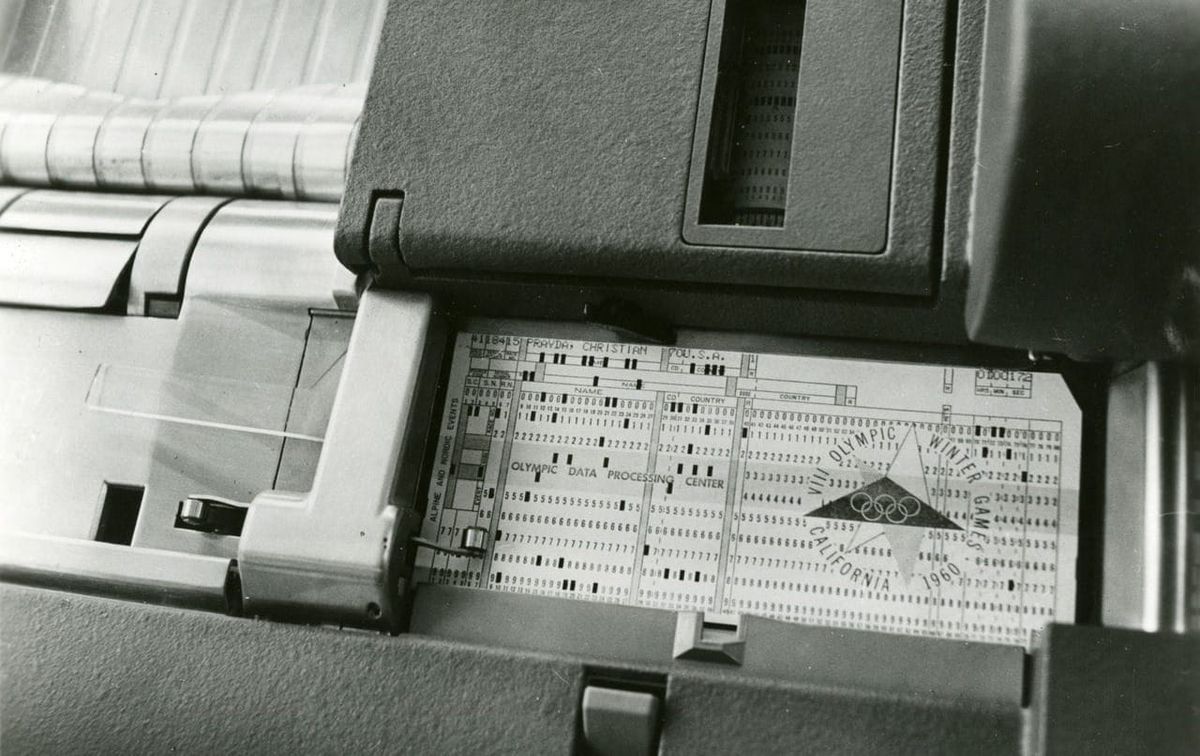
Her name was Bernice Brown. Before Rand, she had been in Ames, Iowa, at the statistics program that became the first statistical laboratory in the country. In 1932, she became the second person ever to earn a master's degree in statistics there. At RAND, once the machine had spat out its million digits. Her job was to make sure they were completely meaningless. So she counted how often each digit appeared. Whether pairs showed up too often, whether runs ran too long, test after test, by hand and on IBM tabulating machines, feeding in tray after heavy tray of punched cards, day after day, for years. Tedious, physical, invisible work.
And at the end of it all, after tests and retests and one final mathematical shuffle to scrub out the machine's last stubborn leanings, Bernice Brown signed off. She wrote that nothing in her tests argued against calling these numbers random. Not these are random. No one can ever prove that. Only I looked as hard as I know how to look and I could not catch them being anything else.
Her certified numbers were eventually printed and bound into a book. A real book published in 1955 that you could order in the mail. It is called A Million Random Digits with 100,000 Normal Deviates. You can still buy a copy today. And people did buy it. Scientists, pollsters, lottery designers. For years, if you needed real randomness, you did not make it. You looked it up. The book even came with instructions. You were not supposed to start on page one. You were told to open the book somewhere unpredictable and read off in an unpredictable direction. Even the Book of Chaos needed you to bring a little chaos of your own.
So this is what randomness cost in 1955. A machine that fought you. A woman who spent years checking every digit. A book of certified nonsense that you kept on a shelf.
Now, around that same time, a man was lying in a hospital bed playing cards. His name was Stanisław Ulam, and he was a Polish-American mathematician. In 1946, he had nearly died. A sudden encephalitis, an emergency brain surgery. And as he recovered, he played solitaire. And somewhere in there he got curious. What are the odds that a given hand of solitaire can be won at all? He tried to work it out properly with pure mathematics. And the calculations just ballooned beyond reach. So he gave up on elegance and just played. Lots of hands. And he counted how often he won. He figured, don't solve the problem. Simulate it. Run it over and over with the deck shuffled differently each time, and let the count become your answer.
Ulam brought that idea back to his colleagues and one of them saw immediately what it could do. His name was John von Neumann, a mathematician of terrifying range who played German marching music too loud in his office, and who was, at that moment, trying to understand what happens inside an exploding bomb. You could write that problem down in theory. Every neutron, every trajectory through a chunk of metal the size of a grapefruit. But solving it would take longer than the universe has been alive. Or you could do what Ulam had done with the cards. Follow one imaginary neutron. When it strikes a nucleus, roll the dice. Does it bounce? Is it absorbed? Does it split the atom? That random roll of the dice would determine the outcome. And von Neumann needed millions of rolls. More than any book could hold.
He came up with a trick. Take a number, square it, then reach into the middle of the answer and pull out a few digits. That's your next number. Now do it again and again. Plain, fast, repeatable arithmetic. And if you squint, the numbers it throws off look random. They jump around and feel unpredictable. They are not. Of course they are not. Feed the trick the same starting number, the same seed. And it hands you the exact same sequence. There is no more chance in it than in a times table. And nobody knew that better than von Neumann. He said it himself. Anyone who uses arithmetic to produce random digits is, of course, in a state of sin.
For decades, the fakes were good enough. Because for most of what we ask randomness to do, a good fake is fine. For weather, for bombs, for the slow patient work of science, von Neumann's sin was pretty much good enough. But then we started asking randomness to do something new. Not to imagine the future, but to keep our secrets. You see, when you send a message you do not want read, or when money moves, the locks that protect all of it are built from random numbers. And a secret built on a fake is just a secret waiting for the right person to notice.
Like in 1995, two graduate students at Berkeley noticed. They pulled apart the web browser Netscape, which was at the time the front door to the internet, and found that the quote, random numbers securing its traffic, were seeded with things like the time of day. Not chaos, just a clock. And so in minutes the locks came open.
And so, after half a century of getting away with it, we discovered that we still needed the real thing. Genuine unpredictability, caught from the physical world. Bernice Brown's kind. Computer science has a word for it. They call it entropy. And we were sent back out to hunt for it.
Here is what we worked out. To keep our secrets, we do not need a million real random numbers. We only need the starting points, the seeds. Once you have a truly unpredictable seed, the fast, cheap arithmetic can take it from there. So the hunt became a hunt for seeds. And once you go looking the mess is everywhere, the thermal noise inside a resistor, the decay of a radioactive atom, the jitter of the exact microsecond you happen to move your mouse. Your computer is scavenging entropy off of you right now, gathering up your tiny accidents and pooling them like rainwater.
And in one building in San Francisco, a company called Cloudflare keeps a whole wall of lava lamps. Blobs rising and folding and splitting and never taking the exact same shape twice. A camera watches the wall, and a computer turns every pixel, its position, brightness, and color, into numbers. The exact posture of every slow molten blob becomes a seed, feeding the cryptographic keys that secure web traffic for millions of sites. If you walked in front of that wall, your shadow would shape the randomness too. Some tiny fraction of the internet's locks would be forged in part from the outline of you.
We built machines that can do almost anything. They can play out fifty tomorrows no problem. They can follow a neutron through a bomb. And lately they can talk. You may have had a conversation with one recently. Every time one of those machines chooses its next word, it rolls dice. And they are von Neumann's dice. Fed at the very start by a seed of real entropy scavenged from the physical world. Because that is the one thing no machine can do.
The most powerful things we have ever built come to the physical world like beggars. To the static. To the lava. The machines cannot make it. Bernice Brown could spend years checking and never prove it. Von Neumann could only fake it, and the sky is giving it away for free. You feel it on the back of your neck as you hurry home.
I'm Daina Bouquin, and this is Found in the Machine. If you enjoy these stories, please rate and review this podcast wherever you listen.
Sources
Brown, B. B. (1968). Delphi process: A methodology used for the elicitation of opinions of experts (Paper No. P-3925). RAND Corporation. https://www.rand.org/pubs/papers/P3925.html
Brown, B. (1948). Some tests of the randomness of a million digits (Paper No. P-44). RAND Corporation. https://www.rand.org/content/dam/rand/pubs/papers/2008/P44.pdf
Charney, J. G., Fjørtoft, R., & von Neumann, J. (1950). Numerical integration of the barotropic vorticity equation. Tellus, 2(4), 237-254.
Cloudflare. (n.d.). How do lava lamps help with internet encryption? Cloudflare Learning Center. https://www.cloudflare.com/learning/ssl/lava-lamp-encryption/
Cloudflare. (2025, March 17). Chaos in Cloudflare's Lisbon office: Securing the internet with wave motion. The Cloudflare Blog. https://blog.cloudflare.com/chaos-in-cloudflare-lisbon-office-securing-the-internet-with-wave-motion
Eckhardt, R. (1987). Stan Ulam, John von Neumann, and the Monte Carlo method. Los Alamos Science, 15, 131-136.
Iowa State College Statistical Laboratory. (1935). Annual report of the statistical laboratory: July 1, 1933 to June 30, 1934. Iowa State College. https://isuu00001library102stg.blob.core.windows.net/digital-objects/statsannualreports/pdf/statsannualreports3414.pdf
Markoff, J. (1995, September 19). Security flaw is discovered in software used in shopping. The New York Times, p. A1. https://archive.ph/Hz0pX
Mercator, V. (2023, October 1). The middle squares method: The first PRNG. VM's Numbers Station. https://vm70.neocities.org/posts/2023-10-01-middle-squares/
Phillips, M. M. (2020, September 24). 'A Million Random Digits' was a number-cruncher's bible. Now one has exposed flaws in the disorder. The Wall Street Journal. https://www.wsj.com/articles/rand-million-random-digits-numbers-book-error-11600893049
RAND Corporation. (2001). A million random digits with 100,000 normal deviates (MR-1418-RC). https://www.rand.org/pubs/monograph_reports/MR1418.html
Summerscales, O. (2023, November 1). Hitting the jackpot: The birth of the Monte Carlo method. Actinide Research Quarterly. https://www.lanl.gov/media/publications/actinide-research-quarterly/1123-hitting-the-jackpot-the-birth-of-the-monte-carlo-method