
Inflection


.jpg&oldid=918565698)
I came across the Voder while looking into encryption and messaging tools used during WWII. I had been working on Tidal Forces and a series of Wikipedia rabbit holes and subsequent Google searches landed me on this photo from the 1939 World's Fair:
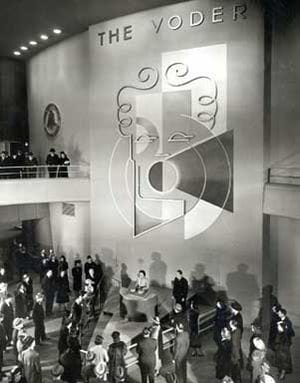
I could not get the image out of my head. Just the spectacle of it. As I started to look more into how this photo came to be, I found out about the Voderettes and Homer Dudley's research, and I knew I had to turn it into something, I just struggled so much with what that would be.
The issue was that I kept getting pulled in different directions with where I wanted to land the story. I wrote three full alternate endings and decided to use none of them. One of the abandoned closes was focused on modern voice banking where people who are losing their ability to speak due to progressive disease are able to preserve them for later use when their physical voices are lost. In that ending I juxtaposed that practice with ways that voices get stolen to scam and impersonate people. But it all felt so unnatural in the context of the rest of the story. It felt like leaving Helen and trying to make a point instead of just letting the story speak for itself. It also felt weirdly moralizing and like it wasn't trusting the listener to connect dots on their own.
So I took a different track. I tried to write a close that more explicitly focused on gender dynamics but the same issues seemed to plague me. The problem emerged again when I tried to instead end the story with a more thoughtful analysis on the question, "who is speaking?" when it comes to the Voder, but it all felt so forced.
I think any of these endings could have worked, but writing is hard, and I couldn't make the words come out in a way that I was satisfied with. So I decided to just stay with Helen and see her story through.
I think it works but I would love to hear feedback from listeners (on this episode and all other episodes too).
Something else I figured I'd share here about writing (this is kind of just stream of consciousness at this point so why not?): the last three episodes have been difficult for me in ways that the ones that came beforehand were not. Because I'm laid off.
I didn't truly appreciate until now just how difficult it is to think creatively while you're preoccupied with finding a new job. I knew it was going to make it harder, but it's so, so much harder.
I've had a bunch of interviews and I'm hopeful, but the stress has really made it incredibly frustrating to try to get my thoughts out of my head in a way that approaches the standards I'm trying to hold myself to. It's also been hard just to keep up with all of the podcast pieces. Hence this newsletter being a day delayed (thanks for your patience, I had three interviews in the last few days and my son started Kindergarten and it's just kind of chaos right now).
Here's hoping I have good news on the job front by the time I write my next newsletter. In the meantime, research can be costly (hello, $36 PDF) so every dollar is appreciated.
You can find ways to support the show here.
What didn't make it into this episode
Here are just a few of the things I didn't incorporate, but considered adding at one point or another during the research process:
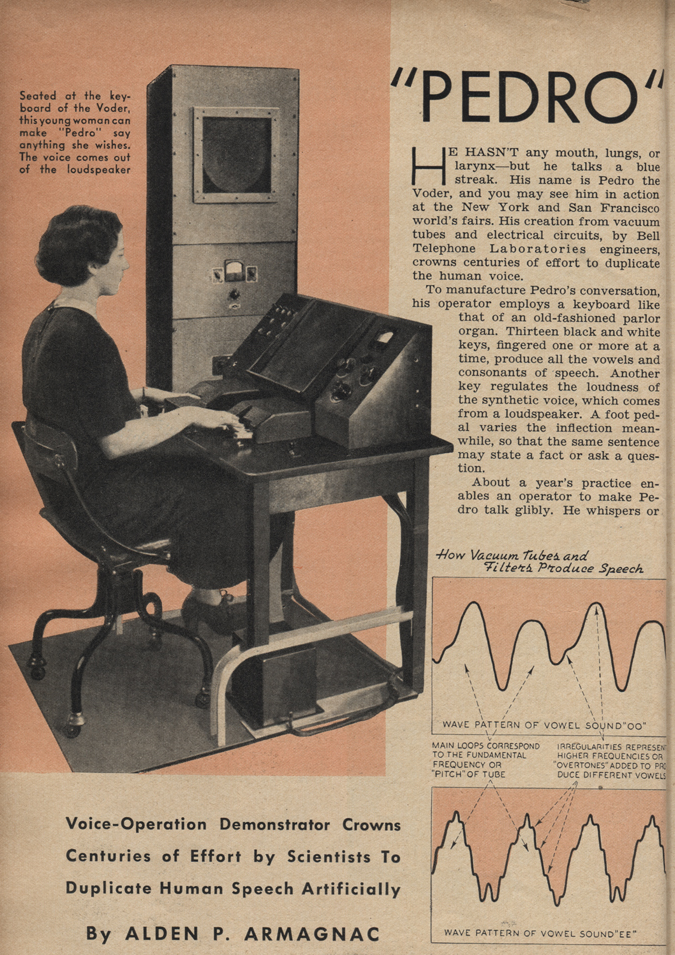
The machine had a name. It was Pedro.
The engineers at Bell Labs nicknamed the Voder "Pedro." The story goes that it was a nod to Dom Pedro II, the emperor of Brazil, who was said to have exclaimed that the thing talks when he saw Alexander Graham Bell demonstrate the telephone at the 1876 Centennial Exposition. So the talking machine was named for a man remembered for being amazed that a machine could talk.
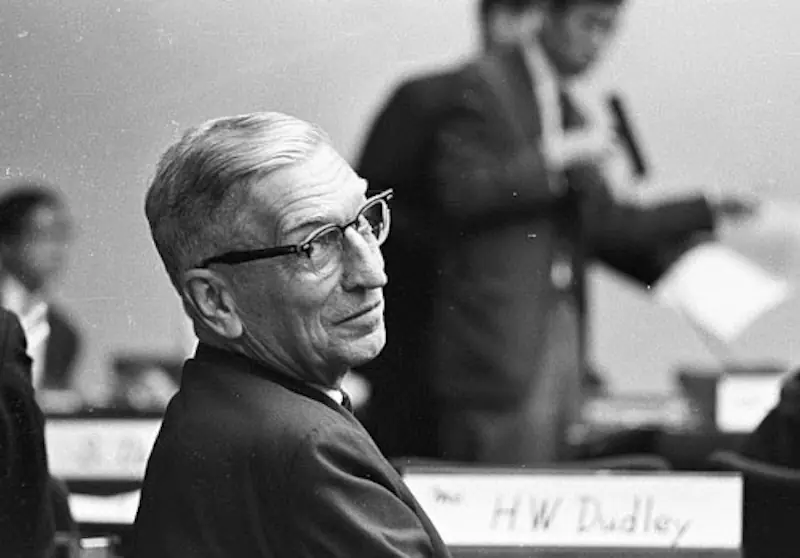
Homer Dudley kept going.
After the fair, Dudley's idea of the voice as a handful of numbers became part of SIGSALY, the system that encrypted calls between Roosevelt and Churchill. There's so much more to that story than I had room for and that may need to be an episode of its own in the future.
Later, Dudley became something like a historian of his own field, writing about the talking machines that came before his, all the way back to Wolfgang von Kempelen's 18th century speaking machine. Eventually he also worked on a Bell Labs kit that allowed hobbyists to build a speech synthesis machine for themselves.
More Voderettes.
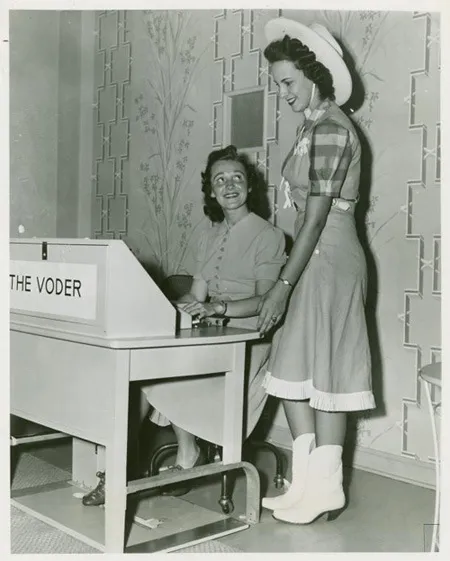
Twenty-four women were chosen to play the Voder at the fair. I found names, and not much else. Sara Johnson, who made the Voder speak Norwegian. Mirjam Ketonen, who made it speak Finnish. Mary Lombardi (née Muldoon). Anna Mae Swenson. Dorothea Mahoney. Ethel Weichard. Mary Barberi. Katharine Barthelmess. Maybelle Duffy. Grace Anderson. Eleanor Harnett. Dorothy Whalen.
I thought about stretching what little I had into something bigger but decided not to. There are both too many names to just read as a list and also not a complete list.
The engineers couldn't play it.
I think the episode implies this, but I want to say it plainly. The men who designed the Voder, with real help from the women, could not really play it.
One account has Stanley Watkins, the engineer who built the Voderettes' initial training program, at the controls making the sound of a locomotive and some farm animal sounds, but nothing beyond that.
The engineers could make it make noise. The women made it talk.
The Episode
Script
Mr Garrett (Archival Audio):
Who saw you?
Voder (Archival Audio):
SHE saw me.
Mr Garrett (Archival Audio):
Whom did she see?
Voder (Archival Audio):
She saw ME.
Mr Garrett (Archival Audio):
Did she see you or hear you?
Voder (Archival Audio):
She SAW me.
Mr Garrett (Archival Audio):
Now you have only heard the Voder speak in one voice. But the Voder has other voices which you can use when Ms. Harper makes a simple adjustment in his mechanism. Helen will you have the Voder say, greetings everybody?
Voder (Archival Audio):
Greetings everybody.
Mr Garrett (Archival Audio):
Now will you have him repeat that in a high voice?
Voder (Archival Audio):
Greetings everybody.
Mr Garrett (Archival Audio):
And now in his best bass.
Voder (Archival Audio):
Greetings everybody.
Daina:
It is the summer of 1939.
Somewhere a merging band is playing. Diesel buses idle. Thousands of people are talking at once. This is the World's Fair. The World of Tomorrow.
Everywhere you look, someone is staring at something. A wooden cabinet that shows moving pictures. A seven foot-tall robot that smokes cigarettes. It is all very loud.
Then you step out of the heat into the Bell Telephone pavilion, and the noise falls away. There is a stage. Behind the stage, a mural, three stories tall, shows a man's face in the Art Deco style. Its mouth wide open, sound waves rolling off his lips. And beneath that giant shouting man sits a woman.
She is dressed impeccably. She sits with perfect posture at a wooden console that looks like a desk. Her hands rest on two small keyboards and her right foot rests on a pedal. A man in a suit steps up to the microphone. He tells you that the machine in front of you is going to speak. Not a recording. Not by passing air through a tube. There are no vibrating strings. This voice is made of nothing but electricity.
He turns to the woman.
And she makes the machine talk.
I'm Daina Bouquin, and this is Found in the Machine.
--
I want you to try something.
Put two fingers against your throat and say, ahhh. You can feel it buzzing. Keep going, but this time change the sound. Ahhh-eee.
The buzz in your throat didn't change, but everything else does. Your tongue moves, your jaw drops, your lips pull back. That buzz is your vocal folds. Two small flaps of tissue. That is the engine and everything above them, your throat, your mouth, your nose, it's a room the buzz has to pass through. And the shape of the room decides which parts of the buzz get louder and which parts get dampened.
You change the room, you change the sound.
The man who figured out how to build that room out of electricity did not want to build a talking machine. Not at first.
Homer Dudley was a preacher's son from Virginia. He trained to be a school teacher and he was bad at it. He could not keep a classroom quiet, so he quit. He went back to school for electrical engineering and got a job at Bell Telephone Laboratories.
By the late 1920s, voices were traveling across the country on copper wire. And copper wire has limits. A human voice is big. It's a messy signal, and every conversation takes up room. Bell wanted to fit more conversations into their wires. So around 1928, Dudley stopped asking how to carry a voice more faithfully. And instead, he started asking what a voice is made of.
In his notes, he describes a person talking almost as if they were a piece of telephone equipment. The brain writes the message. The mouth and tongue shape it. And the buzz in the throat is just the carrier, the thing that gets the message from one head to another. Once you see it that way, you can do something strange to a voice. You can start to take it apart.
Dudley built a machine called the Vocoder, or the voice coder. You speak into one end, but instead of carrying your voice, the machine measures it. There's the pitch and how much energy is in the low frequencies, how much is in the high one. Just a handful of numbers changing slowly, like settings on a dial. Those numbers go down the wire. Not your voice, just the settings. On the other end, another machine makes its own buzz and applies your settings, and out comes something that sounds like you.
And if the shape of the room is just a set of numbers, you can change the numbers. Raise the pitch. Flatten it. You can build a voice that belongs to no one.
When Bell started planning its pavilion for the fair, they wanted to show off the Vocoder. But there was nothing to see. A voice goes in one side and something like a voice comes out the other. Standing next to the smoking robot, it was not something that would draw a crowd.
So someone had an idea. What if you threw away the half that listens and keep only the half that speaks? So instead of having a machine set the dials, you could put a person at the controls instead. A person could learn to press keys to make the room the right shape, and then play it like an organ or something.
But there was a problem. The instrument didn't exist yet, and no one knew how to play it.
In the summer of 1937, Bell brought ten women from its transcription department into the lab. Typists and stenographers. That seemed promising. The prototype did have keys.
The engineers judged two of the ten to be, and this is their word, "unsuited." The other eight weren't considered especially promising either, though two or three might improve with time.
But while the women were learning the machine, the machine was learning them. The keys were too far apart. Several of the women said so. The keys traveled too far when you pressed them. An engineer wrote in his notes that the operators might do better if they didn't have to press so much.
And then there was the pedal. It controlled pitch. If you wanted a voice to go up, what does your foot do? Do you press it down? Or does it make more sense to lift it?
The machine was still being invented around the bodies of the people who were learning to use it.
When it was finished, Belle went looking for the women who could master it. Not typists this time, but telephone operators. Around 320 of them tried. These were women who spent their days at switchboards, pulling and plugging in thick cables, connecting one voice to another. They were trained to be clear, to be pleasant, and to disappear.
Twenty-four women were selected. The press called them girls. The telephone girls. But eventually they did have a name. They were called the Voderettes.
And the one at the front of the room, the one who would train the rest, was Helen Harper.
Mr Garrett (Archival Audio):
Ms. Harper I've been wondering whether our listeners realize how many motions you have to make in the production of a single word. Can you give us some idea?
Helen Harper (Archival Audio):
Well for example in producing the word concentration on the Voder I have to form thirteen different sounds in succession, make five up and down movements of the wrist bar, and vary the position of the foot pedal from three to five times according to what expression I want the Voder to give the word.
Daina:
There were ten white keys, one for each finger that shaped the vowel. Three black keys for the hard sounds. The P, the D, the K.
A bar under her left wrist. Push it one way and the machine buzzes. Push it the other way and it hisses. Buzz is a voice and a hiss is a breath. Every S, every F, every whispered word is a hiss.
And her right foot was on a pedal, raising and lowering the pitch. Without the pedal, every sentence is flat. The pedal is the difference between a statement and a question. Between calm and afraid.
To say one word, she has to take it apart in her head. Separate the breath from the voice. Send the vowels to her fingers, the breath to her wrist, feeling to her foot, and do it all in the time that it takes to say a word.
The Voderettes practiced for three hours a day. They had lessons several times a week. And they did this for more than a year.
They had to first learn single sounds, and then they had to learn to put them next to each other. Because a T sounds different before an E than before an O. And the women had to learn to hear that. They had to hear the sounds that we swallow and the ones that we barely notice. They learned to make the voice whisper. They learned to make it sound old.
By the time Helen Harper sat down under the shouting man, she could make it say a sentence in French. She could make it moo like a cow. And she could make it sing.
Voder (Archival Audio):
Should old acquaintance be forgot and never brought to mind? Should old acquaintance be forgot in the days of auld lang syne?
Daina:
The fair closed in October of 1940. The pavilion came down. The console was packed away. Homer Dudley went back to the lab. But the idea of the voice as a set of numbers, it went to war.
Bell used it to scramble the telephone calls between Roosevelt and Churchill. Dudley worked on that too, alongside a young British mathematician named Alan Turing.
The machine didn't quite make it into the archive. None of the consoles survived. Somewhere between 1940 and now, in one move or another, the desks with the keyboards got lost. But in December 2015, in a storage room in Warren, New Jersey, archivists uncovered two tall equipment racks.
They were the practice units, the ones the women had learned on. The thing she performed on was gone, but the thing she practiced on was found.
And then there's Helen. In September of 1941, a newspaper reported that she was retiring from operator work. She was already married, and now she told the reporter she was going to make marriage her career.
She had made a scrapbook, though. More than a hundred pages of memories about playing the Voder. I don't know what happened to Helen's scrapbook, and I don't know what she put on those pages. But when she left, she had gathered something she wanted to keep.
--
Every voice you hear from a machine today, the one that reads you directions, the one that can say your grandmother's name, is lifeless. But the Voder sat there humming until a woman put her hands on it.
Back in the pavilion, the crowd is laughing. The machine has just said "good afternoon." Someone in the crowd asks it to say it again, but sadder this time. Helen changes the pressure on her foot, and it does.
Above her, the painted man is shouting, and her mouth is closed.
I'm Daina Bouquin, and this is Found in the Machine.
--
Today's episode was brought to you exclusively by our founding Patreon members. You can go to found in the machine.com/support to find our Patreon and other ways you can support the show. And I can't tell you how much I would appreciate a rating or a review wherever you listen to this show. Thanks so much for listening.
References
Schindler, G. E., Jr. (Ed.). (1982). A history of engineering and science in the Bell System: Vol. 3. Switching technology (1925-1975). Bell Telephone Laboratories. https://archive.org/details/historyofenginee0000unse_q0d8
Simon, S. M. B. (2025). Operation Voder: AT&T, Bell Labs, and the labor of techno-utopia at the 1939 New York World's Fair. IEEE Annals of the History of Computing, 47(2), 20-31. https://doi.org/10.1109/MAHC.2025.3528717
Story B. H. (2014). Structure, Movement, Sound, and Perception. Perspectives on speech science and orofacial disorders, 24, 7–20. https://doi.org/10.1044/ssod24.1.7
Synthetic Sound Labs. (2017, December 14). Voder synthesis. https://steamsynth.com/history/voder/
Raphael, L. J., Borden, G. J., & Harris, K. S. (2007). Speech science primer: Physiology, acoustics, and perception of speech (5th ed.). Lippincott Williams & Wilkins. https://books.google.com/books/about/Speech_Science_Primer.html?id=AKaiz3TiIJ8C
Archival Audio
MonoThyratron. (2011, July 9). The Voder - Homer Dudley (Bell Labs) 1939 [Video]. YouTube. https://www.youtube.com/watch?v=5hyI_dM5cGo