
Inheritance

There's a little badge on my GitHub profile that I'd mostly forgotten about. It's a shield-shaped icon with a snowy mountain under a night sky labeled "Arctic Code Vault Contributor." It means that somewhere inside a mountain in Svalbard, on a reel of film, there's code I touched. A few of my old Software Carpentry repos made it in. So did a repo from the FORCE11 Software Citation Implementation Working Group, which I was part of at the time.
Maybe that should have meant something to me, but it really didn't. I had spent years as a librarian thinking about software preservation. I went to the meetings, I was part of the Software Preservation Network, I argued with people about emulation and metadata, and what "preservation" even means. Does it mean the code can run? Does it mean something else?
So when GitHub announced it was going to put a snapshot of public code in an Arctic coal mine, my honest reaction was: neat. Kind of gimmicky.
It felt almost lazy. No attempt to really make anything they were capturing useful. Class assignments next to critical infrastructure. Abandoned experiments next to the Linux kernel. GitHub handles where names could be. It looked careless.
I have a different appreciation for it now. The randomness was partly the point. The ordinary stuff is exactly what never survives. And the work that went into making the film legible to a stranger is incredibly thoughtful, careful thinking about access. I almost called this episode, "Handle with Care" but decided against it at the last moment as that felt like I'd be projecting too much.
What didn't make it into this episode
How can you read Piql film now?

In the episode I spent time on how the code got onto the film (the green light, the chip of tiny mirrors, the silver grains). I barely touched how it comes back off. That's partly because we can't assume the eventual reader will have Piql's machines, but those machines are fascinating.
Piql has a machine called the piqlReader. Film runs continuously past a violet LED light source (405nm) and a high-resolution line-scan camera, and GPUs decode the frames in real time. Piql says it reads back at up to 24 MB per second, about 12 frames a second, and that "anyone with basic 1 hour training can operate" it.
But like I shared in the episode, in theory you don't need the machine.
The guide kept getting translated.
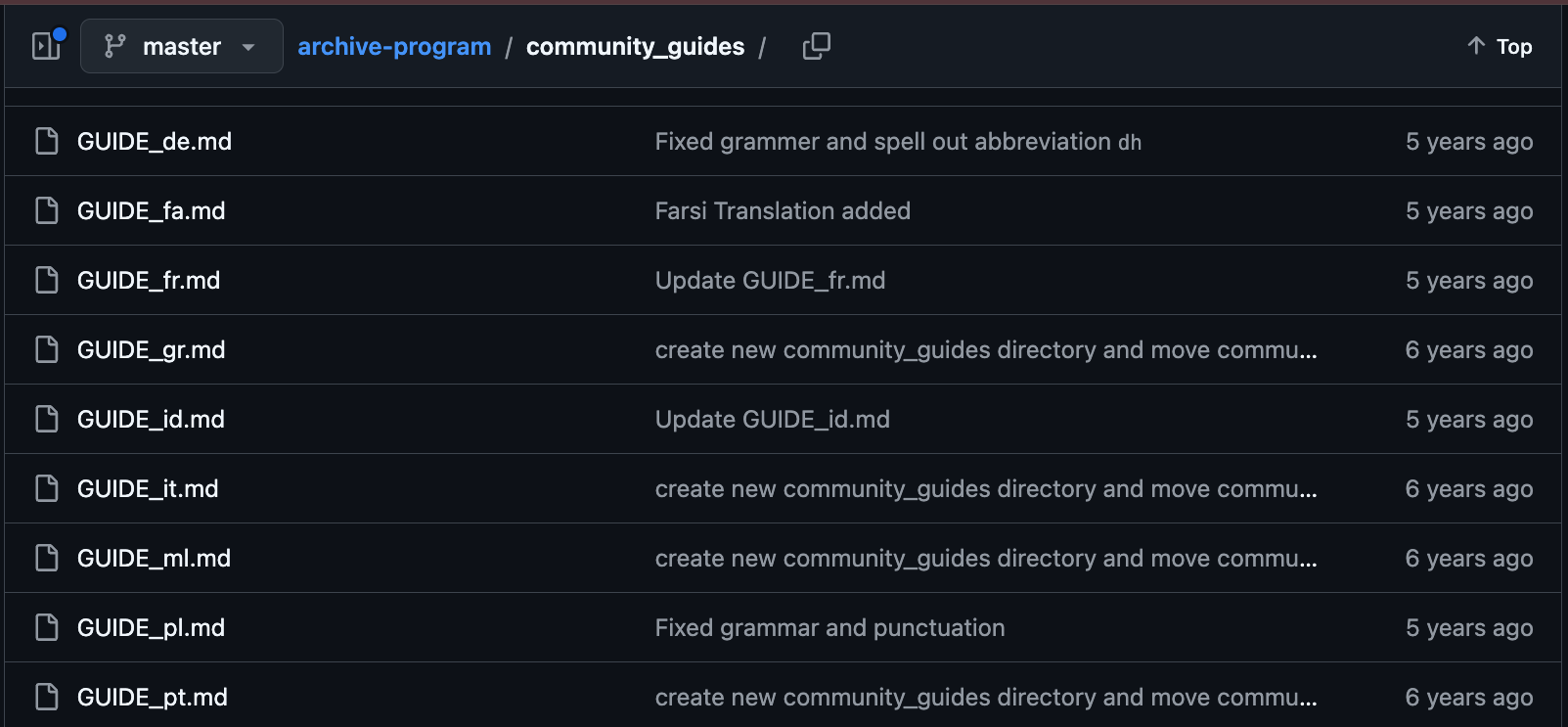
The reels carry the guide in five languages: English, plus professional translations into Arabic, Chinese, Hindi, and Spanish. But the mountain wasn't the end of the guide's life. Back on GitHub, people kept translating it after the reels were sealed away.
The archive-program repo now lists 15 community translations. They live in a Community Guides folder, under a very GitHub disclaimer: "GitHub cannot take responsibility for the contents of these translations."
I love this. Translations that didn't make it onto the reels, written for a reader in the far future who can't be consulted, and the present-day readers just did it anyway.
The send-off that didn't happen.
The snapshot was taken on February 2, 2020. The pandemic happened next.
GitHub's July 2020 post says the original plan was for the team "to fly to Norway and personally escort the world's open source code to the Arctic." The pandemic ended that. They waited until it was safe for their partners to travel to Svalbard. The boxes went to Oslo Airport, rode in the belly of a plane to Longyearbyen, were met by a local logistics company, sat in secure storage overnight, and went into the mine on July 8, 2020.
The people who spent all that time thinking about a reader they'd never meet also didn't get to see it off. When GitHub went back in 2022 with the steel vault and the extra reels, Jon Evans noted that the archive "already acts as something of a pre-pandemic time capsule." A snapshot of the world's code, taken weeks before the world stopped.
Other messages to strangers.
It's hard to talk about the Code Vault without thinking about the other times people have tried to write to someone unimaginably far away. I cut two of them for time and because they ended up feeling like tangents rather than something that carried the story.
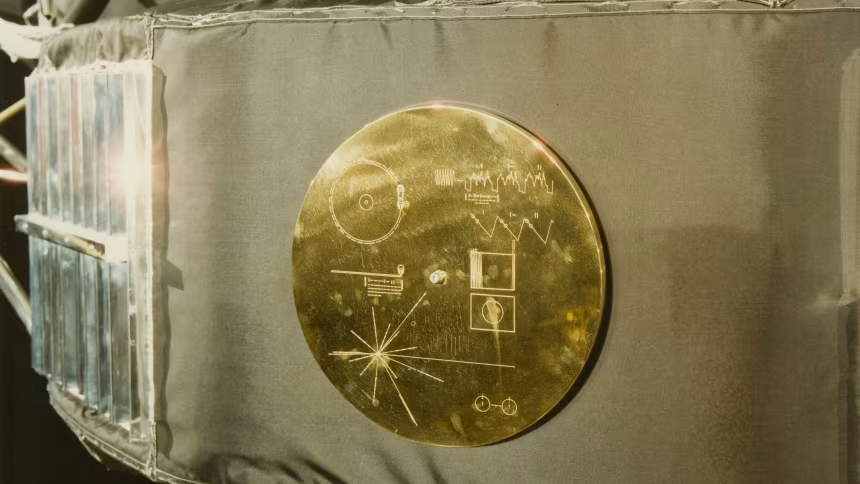
The first I considered including was the Voyager Golden Record. Both Voyager probes launched in 1977 carrying a copy: greetings in 55 languages, 116 images, whale songs, Bach, Chuck Berry. A committee chaired by Carl Sagan chose what went on it. Like the Code Vault guide, the record has to explain itself before it can say anything. The cover shows how to play it, and it uses a hydrogen atom as a unit of time because that's something any reader in the universe might share.
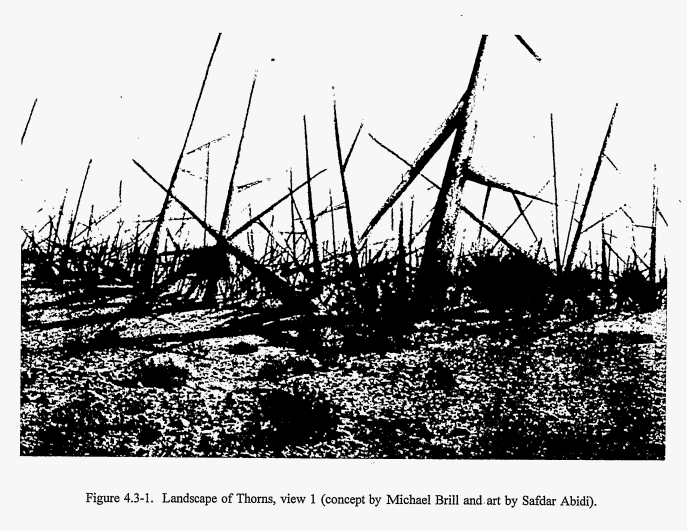
The second is nuclear waste. Warnings at waste sites are meant to last around 10,000 years, longer than any language has lasted. In 1981 the US convened a Human Interference Task Force to figure out how to warn people that far out. The ideas got strange fast. Linguist Thomas Sebeok proposed an "atomic priesthood" that would pass down the warning through ritual and myth. Françoise Bastide and Paolo Fabbri proposed cats bred to change color near radiation, so folklore could carry the message. (99% Invisible later commissioned a song about the ray cats, which you should listen to.)
In the 1990s, Sandia National Laboratories convened panels on markers for the Waste Isolation Pilot Plant in New Mexico. Their 1993 report proposed a message that has become a bit of an internet artifact: "This place is not a place of honor… nothing valued is here."
The thread connecting these is a person. Jon Lomberg was the Golden Record's design director under Sagan, and in 1990 he joined Sandia's markers panel. He told VICE that the engineers believed they had solved the technical problem: "We were there to solve the human one."
The Code Vault sort of feels like a cheerful cousin of these projects. Voyager says we were here. The nuclear markers say stay away. The Code Vault says here's how we did it, (in case it helps).
Is anyone home?
When GitHub launched the program, its FAQ said: "We plan to evaluate the program, and the state of the art of archival technology, every five years." Depending on what they found, they "may then decide to take another snapshot." Five years from 2020 came and went last year.
Someone noticed. In issue #181 on the archive-program repo, a self-described archive enthusiast asks the obvious question: is the GitHub Archive Program still active? The program's website hasn't been updated since 2020. They ask whether the five-year evaluation happened, and suggest GitHub post a status "heartbeat" every five years so people know the program is still alive. They cc'd Jon Evans and signed off with a happy World Backup Day, which I appreciated.
As of this writing, I haven't seen a public answer. The machinery is still there, though. Every public repo still has a "Preserve this repository" checkbox in its settings, on by default. GitHub's docs say opting out keeps your code out of "any long-term archives that GitHub may create in the future." May.
The first copy is the exciting part, the one that gets the press and the blog posts. The hard part is the boring, ongoing commitment: the review, the next snapshot, someone whose job it is to answer the issue. The reels in the mountain don't need anyone to keep going. The program does. A thousand-year archive and a five-year review cycle are two very different promises, and only one of them is written on the film.
So that's where I've landed. I still think a librarian would have built the Code Vault differently. I'm just less sure now that a librarian would have built it better. Somewhere in that mountain is a FORCE11 working group repo full of arguments about how to cite software, waiting for a reader who may not know what software is. I hope the guide helps them. I hope they start from the beginning.
The Episode
Script
On an island in the Arctic Ocean, there is a mountain with a door in it.
The island is called Spitzbergen. It belongs to Norway, although it's closer to the North Pole than to Oslo. For part of the year, the sun never rises, and for another part it never sets.
There are glaciers, reindeer, and polar bears. Beyond the little town of Longyearbyen, people are advised not to travel without protection against them.
For most of the 20th century, people came here to dig for coal. They tunneled into the mountains, following black seams through the rock. But in mine number three, the seams were so thin that modern machines couldn't fit. So the miners kept working with equipment that was 50 years old.
Then in 1996, mine number three closed. The machinery stopped and the miners left.
Years later, though, people began bringing things back into the mountain. Some of them brought film, reels of it, sealed in boxes and carried deep underground. Some of it holds images of paintings. Some of it is the founding documents of nations.
And in July of 2020, a shipment arrived containing something rather more difficult to explain. Computer code.
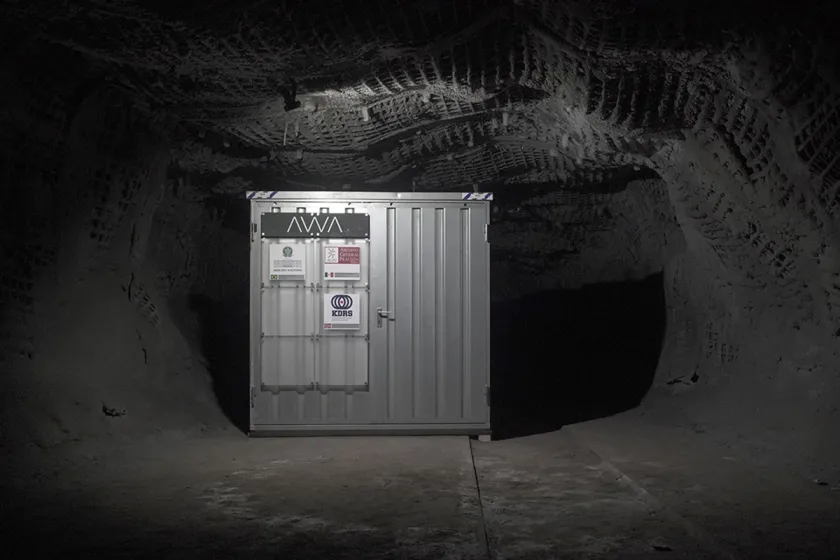
Millions of software projects written by people all over the world had been transferred onto 186 reels of film. Each reel was about a kilometer long. Unrolled end to end, they would stretch more than 100 miles.
The people who brought the code to the mountain hoped that it would be protected for the next 1,000 years.
They left it there for someone.
I'm Daina Bouquin and this is Found in the Machine.
Most of the software you use every day was not written by one person. It was written by many people at once, often strangers, often in different countries, adding to the same work and fixing each other's mistakes. A lot of that work happens out in the open where anyone can read it, use it, or make it better.
It's called open source, and it runs underneath almost everything. Your phone, websites you visit, the machines behind nearly everything you do online. Much of it lives on a website called GitHub.
GitHub is a kind of shared workshop for code. People keep their projects there along with a record of all of the changes made to them. A programmer on one side of the world can propose a fix to something written on the other side, and the people who run the project can look it over and fold it in.
When GitHub started planning its vault, tens of millions of people were using it this way. So in November 2019, GitHub announced that it would preserve millions of public software projects inside a mountain in the Arctic. It gathered advisors, historians, archivists, linguists, archaeologists, people who think for a living about what lasts. And then they had to decide what to keep.
The obvious answer is to keep the important things, the famous projects, the software that everything else depends on, and that's usually how saving things work. The things we remember an era by are mostly the things people decided were worth remembering. One of the advisors, though, a historian and author named Ada Palmer, pointed out a problem with that. She said, we have plenty of letters from wealthy Renaissance aristocrats. What historians would love to have are ordinary people's shopping lists, and almost none of those survive.
Shopping lists are made to be thrown away. So GitHub decided to try to keep the shopping lists on purpose. The ordinary things. On February 2nd, 2020, it took a snapshot. Every public project on the site that met a few simple rules was copied at once, frozen in that moment. The rules said nothing about quality. If someone had worked on a project in the past 80 days, it went. If at least one person had marked it as worth keeping and it had been touched in the past year, it went. If a project was popular enough it went no matter how long it had been.
The famous software is in there. But so are class assignments. Things that were started and abandoned. Weird ideas that might someday turn into something useful. There was code written by students building robots trying to pass information from a camera to their machines.
Not everything made it. Private projects weren't included, and plenty of forgotten projects didn't meet the rules. But millions did.
The code captured on that day in February went to Drammen, a city outside Oslo, to a company called Piql, and into a machine. The machine is called a piql writer. Inside it, there is a green light and a chip covered in millions of tiny mirrors, each one much smaller than a grain of sand. The mirrors work something like the slats of a window blind. Each one can tilt. Tilted one way, it sends a speck of green light down onto the film. Tilted the other way, it sends the light off into the dark. Arrangement after arrangement builds up a frame, a pattern of light and dark. Then the mirrors move and the film moves 20 frames a second. At that pace, one reel takes just under an hour. All 186 reels make up about a week of light.
The film is old technology, just a strip of polyester, 35 millimeters wide, the same size as movie film. It's coated with gelatin holding tiny crystals of silver salt. Where the green light lands, the crystals change, but it's nothing you could see yet. The film has to go through chemicals the way a photograph does. The touched crystals then can become grains of metallic silver and the rest wash away. That's what the code becomes. Grains of silver sitting on plastic. Hold a strip up to a window and it looks gray. Under a magnifier, the gray comes apart.
Each frame has millions of tiny black and white squares packed edge to edge. Someone with a camera and the right instructions can convert those squares back into files. And once the writing is done, the machine can be switched off. The film doesn't need power to remember. It can sit in a box while the computers that made it go obsolete. And the computers that replaced those go obsolete too.
But someone would have to know what they were holding. So the makers gave every reel the same beginning. First, a length of empty film. Then a single frame with nothing on it but a solid black rectangle in one corner. A mark to measure from. After that comes pages a person can read, actual letters, photographed onto the same film as the code. This is a guide, instructions that can travel with the thing that they explain.
The man in charge of the program, Jon Evans, was a software engineer and he was also a novelist. Now he had to help write for a reader who might have never seen a computer. So the guide starts small. All you need, it says, is a source of light and some way to magnify what's in front of you. The guide tries to imagine who is reading. Maybe they have computers far beyond ours, but maybe they have none at all.
To explain what a file is, the guide asks the reader to think of data as sand and a file as a bag that holds it. By the time anyone reads that, they will already be holding the sand, the grains of silver on a strip of plastic in their hands.
At one point, the guide stops and acknowledges how hard all of this might be. It says, "if this complexity is difficult and costly for you, we apologize." The guide went on to the film in five languages: English, Arabic, Chinese, Hindi, and Spanish. And the first file on every reel holds the Universal Declaration of Human Rights in more than 500 languages. If a reader knows one of those languages, it might help them find their way to the others. No one knows which language, if any, the reader will understand.
On July 8th, 2020, the film reels were taken to the old coal mine, to a chamber deep in the frozen mountain. Outside, it was the season when the sun doesn't set. And later that month, people began noticing something new on their GitHub profiles. A small badge that said their work had gone to the Arctic. It was a thank you and a way for GitHub to draw attention to the project.
On a forum for student robotics teams, people were comparing notes about what had made it into the archive. One of them posted under the name bobbysq. They had written a little program that passed what a camera saw along to a robot, and it had made it into the vault. And it didn't have a README. That little document that usually explains what a piece of software is and how to use it. The student addressed whoever might find it, saying, "I would also like to apologize in advance to the aliens, post-society humans, or evolved dolphins that find my code. Sorry, there's no readme.md yet. Maybe I'll head up there and write it down for you someday."
In 2022, GitHub went back. They brought a reel of books and documents a person could read by eye about computers and how they're made. They brought a full-text snapshot of Wikipedia in all five of the archives languages. They brought a complete stack overflow data dump. And they brought a steel vault for the film. It was about 3,000 pounds and etched with art. The earth on the front and the Milky Way on the back.
Alexander Rose of the Long Now Foundation had told them, "If you don't make it beautiful, it's for sure doomed."
For decades, mine number three gave up what was inside of it. People came in on their shifts and carried the coal out.
Now it holds things. Boxes to leave alone and a door to close behind you.
No one has set a date for the reader to arrive. A thousand years is how far the makers hoped the film could reach, but someone could need it sooner. Someone could open a box just to see and put it back.
And if they do, they will have to find the beginning. A length of empty film. A black rectangle in one corner.
They will need some light and a way to magnify what comes next.
"You may be reading this one year from now or one thousand. But either way, we hope its contents and perhaps the very concept of open source are useful to you."
I'm Daina Bouquin and this is Found in the Machine.
If you enjoy my stories, please share them or leave a rating or a review wherever you listen. They really do help people find the show and they mean a lot to me. And if you'd like more content from me, you can join the show's Patreon. Patreon members get access to Found in the Margins, my mini bonus episode series that alternates with the main feed. The most recent Margins episode was called "Rope Mother." You can find the Patreon and more ways to support the show by going to found in the machine.com/support. Thanks for listening, guys.
References
bobbysq. (2020, July 19). [Reply to the discussion "Robotics repositories in the Arctic Code Vault"]. Chief Delphi. https://www.chiefdelphi.com/t/robotics-repositories-in-the-arctic-code-vault/386554
CNCKing. (2023, January 23). Custom GitHub Arctic Code Vault fabrication. https://cncking.com/custom-github-arctic-code-vault-fabrication/
Evans, J. (2022, September 20). "If you don't make it beautiful, it's for sure doomed": Putting the Vault in GitHub's Arctic Code Vault. The GitHub Blog. https://github.blog/open-source/maintainers/if-you-dont-make-it-beautiful-its-for-sure-doomed-putting-the-vault-in-githubs-arctic-code-vault/
Film preservation for 500 years on film. (n.d.). The Broadcast Bridge. Retrieved October 27, 2026, from https://www.thebroadcastbridge.com/content/entry/940/film-preservation-for-500-years-on-film
Gilbert, S. (2018, April 26). The man who helped design a 10,000-year nuclear waste site marker. VICE. https://www.vice.com/en/article/jon-lomberg-nuclear-waste-marker-v25n1
GitHub. (2022). github/archive-program/community_guides [GitHub repository]. Retrieved October 27, 2026, from https://github.com/github/archive-program/tree/master/community_guides
GitHub. (2020, November 5). A guide to the GitHub Code Vault. https://github.com/github/archive-program/blob/master/GUIDE.md
Long Now Foundation. (2019, October 10). How to send messages 10,000 years into the future. https://longnow.org/ideas/how-to-send-messages-10000-years-into-the-future/
Mars, R. (Host). (2014, May 12). Ten thousand years (No. 114) [Audio podcast episode]. In 99% Invisible. Radiotopia. https://99percentinvisible.org/episode/ten-thousand-years/
Metcalf, J. (2020, February 3). The Arctic Code Vault starts production and your open source projects are being archived. The GitHub Blog. https://github.blog/open-source/maintainers/the-arctic-code-vault-starts-production-and-your-open-source-projects-are-being-archived/
Metcalf, J. (2020, July 16). GitHub Archive Program: The journey of the world's open source code to the Arctic. The GitHub Blog. https://github.blog/news-insights/company-news/github-archive-program-the-journey-of-the-worlds-open-source-code-to-the-arctic/
Piql. (2026, October 19). piqlFilm. https://piql.com/technology/film/
Piql. (2026, October 19). piqlWriter. https://piql.com/technology/writer/
Piql. (2026, October 27). piqlReader. https://piql.com/technology/reader/
Sabliński, J., & Trujillo, A. (2021). Piql. Long-term preservation technology study. Archeion, 122, 13–32. https://doi.org/10.4467/26581264ARC.21.011.14491
Trauth, K. M., Hora, S. C., & Guzowski, R. V. (1993). Expert judgment on markers to deter inadvertent human intrusion into the Waste Isolation Pilot Plant (Report No. SAND92-1382). Sandia National Laboratories. https://doi.org/10.2172/10117359
Voyager Golden Record. (n.d.). In Wikipedia. Retrieved October 27, 2026, from https://en.wikipedia.org/wiki/Voyager_Golden_Record