
Page Turner


This episode was a hard one to keep small. The deeper I got into the optophone, the more I kept finding recordings: tapes, demonstrations, training materials, little clips of machines chirping and humming their way across printed pages. There is so much audio out there, and I could only use a tiny bit of it.
I also had to make a choice early on. I could tell the story of the machine and everything it turned into over the next sixty years, or I could stay with Mary. I chose Mary. That meant leaving out most of the later reading machines, almost all of the other people who used them, and a frankly ridiculous amount of material about Edmund Fournier d’Albe, who I seriously considered giving his own bonus episode.
So this newsletter is mostly a list of places to go listen and read for yourself. I hope you fall down the same rabbit holes I did.
What didn’t make it into this episode
Go listen to the machines.
If you only click one link from this newsletter, make it Mara Mills’s Optophones and Musical Print on Sounding Out! It’s a short history of the optophone and the reading machines that followed, and it’s full of embedded audio. A few highlights:
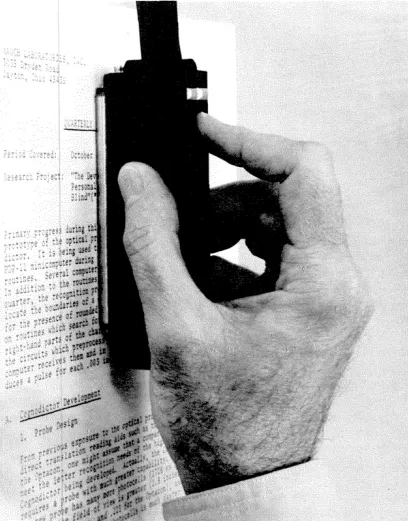
- The original optophone vs. the “compressed” optophone. A 1965 recording by physicist Patrick Nye plays the same eight lowercase letters on both. The compressed version tried to cut down on all the redundant chords by sounding only certain features of a letter, like whether it had an ascender or a descender.
- Wuhzi. Researchers at Haskins Laboratories built what they called a machine dialect of English, a set of speech-like sounds standing in for written words. They were testing whether people could read faster by ear with something closer to speech than with musical tones. (They decided yes.)
- The Visotoner. A portable nine-channel optophone built by Mauch Laboratories and demonstrated on tape in 1971 by Harvey Lauer. Lauer told Mills he liked its sound better than other optophones and compared it to Debussy.
- The Cognodictor. A spelled-speech character recognition machine. In the clip, Lauer reads the same page with the Cognodictor and the Visotoner at once, and the Visotoner catches the Cognodictor’s spelling mistakes.
- The Stereotoner. A ten-channel stereo optophone that Mauch built in 1972 at the request of Lauer and other blind readers. There’s a short promotional video.
- A Kurzweil Reader familiarization tape. The machine that more or less ended the optophone era, and even it needed training tapes.
You can also hear the optophone itself in Matthew Rubery’s “How we read”: The optophone video, and Mary’s own tape-recorded letter to Harvey Lauer (the archival audio in the episode) is in Optophonic Reading, Prototyping Optophones by Tiffany Chan, Mara Mills, and Jentery Sayers in Amodern. That piece also covers their work building new optophones from the old designs, which is just a wonderful idea.
The other readers.
Mary was the most accomplished optophone reader, but she wasn’t the only one. Her twin sister Margaret learned the system alongside her in 1917. Mary went on to teach other blind readers herself.
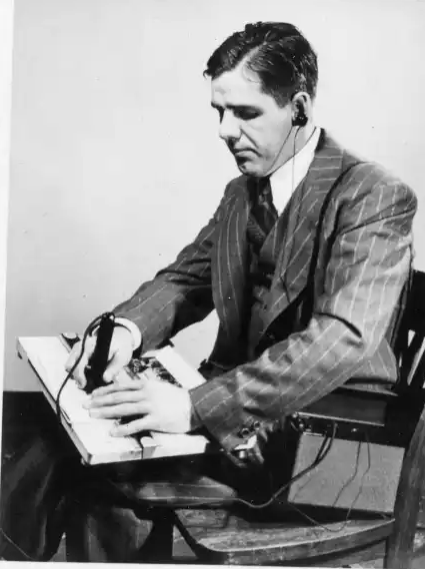
In the US, RCA tested its own optophone, the A-2, on three blind readers. One of them, a ham radio enthusiast named Joe Piechowski, was more of a technical collaborator than a test subject. He reached about 20 words per minute, which RCA decided was too slow. That judgment helped push the company toward building machines that would recognize letters on their own, an early step toward OCR.
Then there’s Harvey Lauer, who was blind himself and spent more than thirty years at the Veterans Administration testing reading machines. He reached around 40 words per minute on the Visotoner and used it to read mail, identify money, check his own typing, and read charts. He always believed the best machine would do both: talk to you when it could, and let you hear the shape of the page when it couldn’t.
Lauer and Mary traded tapes and braille letters in the 1970s. In one braille letter, she wrote, “I think that stereotoner signals are the clearest I have heard.” Fifty-plus years after her first optophone, she was still listening closely.
Fournier d’Albe was everywhere.
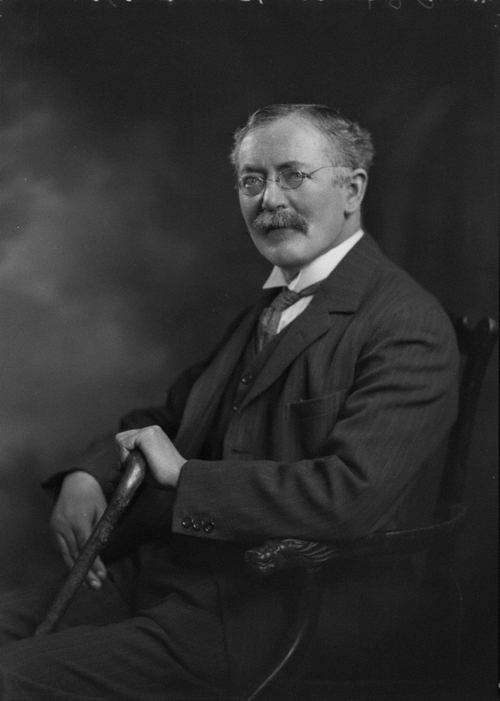

I mentioned in the episode that he was an unusual man with interests that ranged from electricity to spiritualism and that he was friends with Houdini. That barely scratches the surface. A partial list:
- He was born in London in 1868 to a French Huguenot family that had settled in Ireland, and he worked as an assistant to the physicist George Francis FitzGerald at Trinity College Dublin.
- He was one of the founders of the pan-Celtic movement. He helped organize a Pan-Celtic Congress in Dublin, was initiated into the Welsh Gorsedd, and published an English-Irish dictionary and phrase book in 1903.
- He’s credited, along with Robert Boyd White, with the first translation of an Irish text into Esperanto in 1908. In 1926 he gave a lecture, in Esperanto, on wireless telegraphy and television.
- He served as secretary of the Dublin section of the Society for Psychical Research and was a believer in spiritualism for years. Then in 1921 he investigated the medium Kathleen Goligher, caught signs of trickery, and wrote a book about it. He still believed in the supernatural, though.
- He wrote a biography of William Crookes and translated books by Camille Flammarion and Jean-Henri Fabre.
- He taught in Lahore at the University of the Punjab starting in 1914, which is part of why the First World War interrupted his optophone work.
- He wrote a whole book about selenium called The Moon Element (selenium is named for the moon). In it, he describes using optophone technology to make music, transcribing compositions and building a little keyboard instrument that played pure electrical tones you could only hear through the telephone receivers.
- He also wrote Hephaestus; or, The Soul of the Machine and Quo Vadimus? Some Glimpses of the Future, both from 1925. Both are free on Project Gutenberg.
And the optophone had an afterlife in art. It shows up briefly in Finnegans Wake, the Dada artist Raoul Hausmann patented his own optophone in 1935, and Francis Picabia painted two optophone portraits in the early 1920s.
So yes, maybe a bonus episode someday.
The Episode
Script
Daina Bouquin:
It is nineteen eighteen, and Mary Jameson is reading.
She was born blind, and she usually reads braille. But the page in front of her is an ordinary printed page. Black ink on white paper. There is a machine between her and the page. A delicate arrangement of lenses and wires, a spinning disc and a small piece of an element called Selenium. As the mechanism moves slowly across the print, the machine sends a collection of musical notes into a pair of telephone receivers.
And Mary listens. She hears in the sounds one letter, then another. Eventually, a word. It is slow work. And the machine is temperamental. Its focusing mechanism is so delicate that someone walking heavily across the room can knock it out of alignment.
But Mary has been practicing. By the summer of 1918, she can read about one word per minute. And that is enough to prove that it is possible.
I'm Daina Bouquin and this is Found in the Machine.
In June 1912, a physicist named Edmund Edward Fournier d'Albe arrives at an optical convention in London with an invention.
Fournier d'Albe is an unusual man. A scientist and writer with interests ranging from electricity to spiritualism. He knows some of the most prominent thinkers of the age. He has befriended Harry Houdini. And he has spent years studying the properties of a chemical element called selenium.
Selenium does something peculiar. In darkness, it resists the passage of electricity. But if you shine a light on it, that resistance changes. Alexander Graham Bell had used it in an instrument that transmitted sound on a beam of light. And in Poland, an ophthalmologist named Kazimierz Noiszewski had used it as an artificial eye to help blind people tell light from darkness.
And Fournier d'Albe is working on a very similar idea. His instrument is housed in a slender wooden box. Inside is a selenium cell that responds to light, producing changes in an electrical signal that a person can hear through telephone receivers. Point it toward a window and the sound changes. Move it toward a corner and it changes again. He calls it the exploring optophone, and he imagines it helping blind people navigate the world.
The newspapers are delighted. But among the people who learn about the invention is a blind solicitor named Washington Ranger. Ranger writes to Fournier d'Albe. What concerns him is how a blind person might earn a living. A person who can detect a window has learned something about a room. But a person who can read an ordinary printed page has access to an enormous part of the working world. Letters, newspapers, documents, books.
So Fournier d'Albe begins working on another machine.
By 1913, he has an experimental reading optophone. The First World War interrupts his work, but he returns to it, building an instrument that turns the shapes of printed letters into sounds. To understand how this machine works, imagine a capital T. One upright line topped with a horizontal stroke.
Now imagine a tiny vertical row of lights moving slowly across that letter from left to right. Each of the little lights flickers at a different rate, corresponding to a different musical note. The flickering comes from a spinning disc pierced with holes laid out in concentric rings passing in front of a lamp. When the light falls on white paper, it reflects back toward a selenium cell. And the listener hears a chord. All of the notes are on.
But black ink reflects much less light. So when the light passes over the ink, some notes disappear. So as the row of lights moves across the T, the beginning of the top stroke interrupts a note. Then the vertical line interrupts the whole chord. The light continues past the vertical line with only the top stroke continuing to interrupt one note.
A person listening through the device has to recognize the letter T by the notes that disappear. It's reading by absence.
In the spring of 1917, Fournier d'Albe demonstrates the instrument to representatives of the National Institute for the Blind. He manages to read an unfamiliar newspaper passage, but the demonstration does little to convince them.
This machine is slow. It takes extensive training, and its practical usefulness remains uncertain. And these are reasonable objections.
But Fournier d'Albe keeps looking for people willing to learn. That year he meets 18-year-old Mary Jameson and her twin sister Margaret.
The sisters already know Braille, and now they begin learning the strange new system of sounds. And Mary takes to it.
Not immediately. There is nothing immediate about learning the optophone.
She must memorize the musical patterns of printed letters. She must distinguish sounds that can be maddeningly similar. And she has to manage the machine itself. Page must be positioned correctly, and the mechanism must be focused. The scanner must be moving at the right speed. Too quickly and the letters become an unintelligible stream. But too slowly and she loses track of what came before.
But she practices. And by August 1918, she gives a demonstration at King's College in London. Someone in the audience has connections to Barr and Stroud, a Scottish company known for precision optical instruments. And the company agrees to build a more practical optophone.
The machine is sturdier with a curved glass surface on which a book can rest. Its scanning mechanism moves more reliably across the page. And its designers add a second Selenium cell so the machine can sound the black ink itself.
Now, instead of listening for the notes that disappear, Mary can listen for the notes that are there. But the signals are faint. And after an hour or two, the selenium cells begin crackling.
In June 1920, Fournier d'Albe announces in the journal Nature that the problem of opening the world's literature to blind readers has been solved. It is a remarkable claim and entirely premature.
The Optophone is expensive. It remains difficult to operate, and it demands an enormous investment of time. Mary knows this better than anyone. By now she is its most accomplished reader. She travels to demonstrations and exhibitions, showing audiences what the machine can do. And she is also helping to design it.
At Bar and Stroud's London branch, she works with an engineer named A. M. Lundie. She suggests changes to the musical notes so that certain letters are easier to tell apart. She asks for stronger signals to hear over the noise of the mechanism itself. She works with Lundie on a device that moves between lines and on a feature for reading italic type. She teaches other blind people how to use it.
And her speed keeps climbing. From one word per minute to 25, then 40, then 60.
She is doing the labor of a developer and a public ambassador, but she is doing it informally. So her father, Thomas Jameson, writes to Barr and Stroud. He wants the company to recognize her vital work with proper compensation and a formal place. Barr and Stroud pays Mary for individual demonstrations, but never gives her regular employment.
Still, she keeps working.
And in 1921, Mary sits down to read a novel. It is The Warden by Anthony Trollope. Published in 1855, it tells the story of a kindly clergyman caught in a dispute over money at a charitable institution. Mary places the book on the Optophone. She finds the first line and she begins to read.
She no longer labors over individual sounds. Familiar patterns begin to come together. And she starts to notice something. The more she reads a particular author, the easier it becomes to anticipate what comes next. A writer has habits, certain turns of phrase. But when she begins a book by someone new, the work becomes harder again. So she deliberately decides to read writers who differ widely in style. She reads Nathaniel Hawthorne's The Scarlet Letter, an autobiography by Herman Charles Merivale, and others. And she finishes The Warden.
But even as Mary becomes more proficient, the future of the Optophone is becoming less certain. Most people who try it never approach her speed, and few schools can afford one. Braille is already established, reliable, and widely taught.
By 1922, Barr and Stroud is doubting whether there will ever be enough customers.
By 1928, the company has stopped pushing the machines.
Fournier d'Albe dies in 1933.
Only a small number of Optophones have been sold.
But Mary Jameson keeps reading.
In 1944, the organization St. Dunstan's takes up the British Optophone and replaces the old selenium cells with photoelectric cells that are much louder. In the 1950s, a man named W. K. Hill improves the focusing, making it easier to tell similar letters apart. Mary tests the changes.
Meanwhile, across the Atlantic, engineers at RCA are building a machine that tries to identify the printed characters itself. The effort is led in part by Vladimir Zworykin, a man who had examined Fournier d'Albe's Optophones decades earlier. RCA's work is an early step toward what we now call optical character recognition.
The task of deciphering the page is beginning to move from the person into the machine.
It is 1966. Nearly 50 years have passed since Mary first sat down with the Optophone. She records a presentation for a conference on reading machines in the United States. She remembers the delicate early machine. But most of her talk concerns the machines being built now.
She's still asking questions to improve listening devices. She wonders which notes are easier to distinguish and which letters are harder to recognize.
In the years that follow Mary's presentation, she exchanges letters and tape recordings with blind Americans working on newer machines. One of them, Harvey Lauer of the United States Veterans Administration, sends her a device called a visotoner. It's smaller and more portable than her old Optophone, but it is hard to keep aligned with the text and it struggles with certain colors of ink. She weighs the two machines. She knows what she likes about her old one and she knows what she wishes it could do. She knows what it already does.
Mary Jameson (archival audio):
The Optophone is as much a part of my everyday life as the typewriter or telephone. Sometimes the print is too big for the Optophone array. At others, italics are too sloping. While noting the shortcomings of the Optophone, I can use the valuable facilities it already gives. I hope this situation makes me of use in solving vital print reading problems which remain.
Daina Bouquin:
Mary Jameson passes away in 1980. By then the Optophone belongs to an earlier age. Computers will soon recognize printed letters on their own and read them out loud.
But there is a photograph of Mary, taken decades earlier. She is seated at an Optophone reading The Warden. She wears a pair of telephone receivers over her ears. The book rests on the machine in front of her. Somewhere inside a disc is spinning and light is falling across the printed page. And the machine is making its little collection of sounds.
Mary knows what they say.
I 'm Daina Bouquin and this is Found in the Machine.
If you enjoy my stories, consider passing them along or leaving a rating or a review wherever you listen. And if you'd like to support the show, you can go to found in the machine.com/support, and you can find our Patreon and other ways to support the show. The most recent bonus episode received by Patreon members was about the twenty thirty-eight problem. Thanks for listening, guys.
References
Chan, T., Mills, M., & Sayers, J. (2018). Optophonic reading, prototyping optophones. Amodern, 8. https://amodern.net/article/optophonic-reading/
Fournier d’Albe, E. E. (1925). Hephaestus; or, The soul of the machine. E. P. Dutton & Co. https://www.gutenberg.org/ebooks/73186
Fournier d’Albe, E. E. (1920). The optophone: An instrument for reading by ear. Nature, 105(2636), 295-296. https://archive.org/details/sim_nature-uk_1920-05-06_105_2636/page/294/mode/2up
Jameson, M. (1966). The optophone: Its beginning and development. Bulletin of Prosthetics Research, 10(5), 25-28. https://www.duxburysystems.org/downloads/library/history/va_1966_25.pdf
Mills, M. (2015, January 5). Optophones and musical print. Sounding Out! https://soundstudiesblog.com/2015/01/05/optophones-and-musical-print/
St Dunstan’s. (1954, February). Chairman’s notes. St Dunstan’s Review, 37(413). https://blindveterans.maxarchiveservices.co.uk/uploads/st_dunstans_review/0413_Feb_1954_compressed.pdf
Thomas, E. (2021, June 23). A century ago, the optophone allowed blind people to hear the printed word. IEEE Spectrum. https://spectrum.ieee.org/a-century-ago-the-optophone-allowed-blind-people-to-hear-the-printed-word
Archival Audio
Jameson, M. (ca. 1970). [Tape-recorded letter to Harvey Lauer comparing the British optophone and the visotoner] [Audio recording]. Harvey Lauer personal collection; digitized by Mara Mills. In T. Chan, M. Mills, & J. Sayers, Optophonic reading, prototyping optophones (Fig. 9). Amodern, 8. https://amodern.net/article/optophonic-reading/
Rubery, M. (2015, August 23). “How we read”: The optophone [Video]. YouTube. https://www.youtube.com/watch?v=w0wuIv1JVGU